



Open Hardware and Embedded Devices/Hardware With GNU/Linux
Submitted by Roy Schestowitz on Thursday 5th of November 2020 11:22:42 PM
Filed under 


-
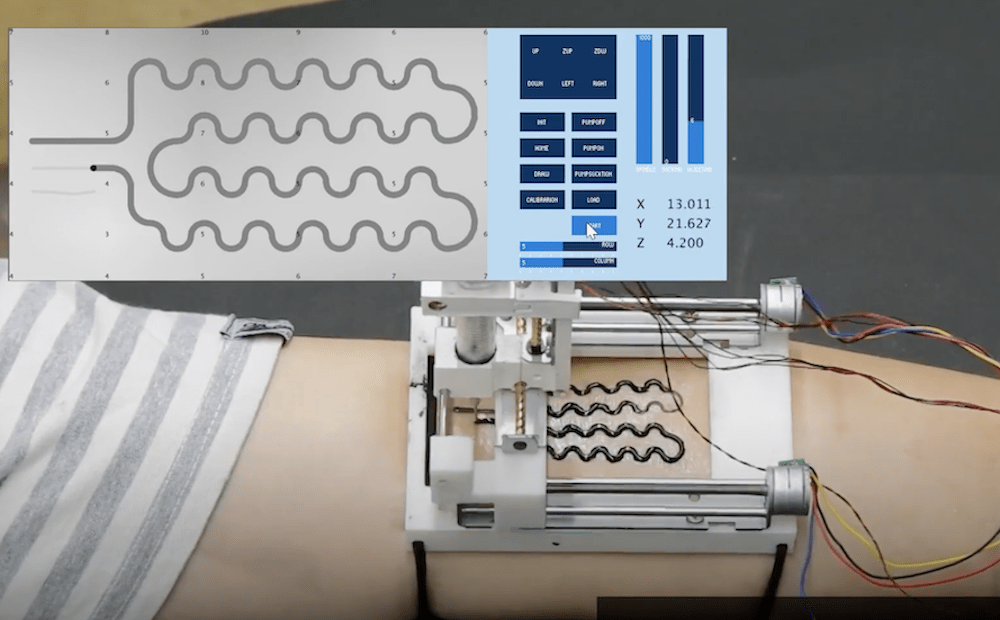
Fabricate flexible electronics directly on your skin with the BodyPrinter
What if you could print circuit “tattoos” right on your body? While the idea of augmentation with a pre-assembled electronic sticker isn’t new, the technique proposed by a team of KAIST and MIT Media Lab researchers takes things to a new level.
Their small BodyPrinter device — composed of a custom 3D-printed plotter with a movable head and a mounted extruder — can be strapped directly to multiple body parts, including fingers, arms, back, stomach, forehead, neck, laps and shoulders. After a little calibration, it deposits conductive ink on a “liquid bandage” substrate that’s already attached directly to a subject’s skin.
-
An old-school “neon” sign made with LEDs
Can you make an Arduino-controlled neon sign? While certainly possible, such a setup would involve working with rather high voltages, and the skill to shape glass tubing. As an easier alternative, Max Danilin (who also goes by “gabbapeople”) created an animated pub display using lengths of LED strips made to look like old-school neon tubes.
Although such tubes don’t quite have the same glow as their true neon counterparts, shaping segments was a matter of arranging them on a wooden backing with nails for support. Everything is powered by an Arduino Uno, programmed using the XOD IDE. This activates different LED segments via a pair of eight-channel MOSFET switch arrays.
-
Penguino Feather 4260 LoRa development board features RAK4260 module
Adafruit Feather form factor has become more popular in recent years with third-parties introducing Feather compatible boards such as the Giant Board (Linux capable), OrangeCrab (FPGA), or FeatherS2 (ESP32 WiFi + Bluetooth), and as well as FeatherWing add-on boards.
Azerbaijan based MakerTronika Labs has launched their own Feather compatible board with LoRa connectivity: Penguino Feather 4260. The development board is powered by a RAK4260 module based on SAMR34 LoRa SiP and supports both 868 and 915 MHz bands.
-
Orange Pi Zero2 Is A Powerful And Juicy Rival To Raspberry Pi Zero For Just $15.99
It has been over a year since Shenzhen Xunlong Software announced its enticingly priced Orange Pi Zero2 mini PC, which as you might imagine is intended to compete against the Raspberry Pi Zero. If you have been waiting around for it to arrive, you patience has finally paid off—it is available to order starting at around $16.
Like the Raspberry Pi line of mini PCs, this is a single board computer (SBC) that packs a bunch of hardware and features into a rather minuscule and affordable package. The heart and soul of the Orange Pi Zero2 is the Allwinner H616 SoC, consisting of a quad-core 64-bit Arm Cortex-A53 processor clocked at 1.5GHz, and a Mali G31 MP2 GPU for graphics.
-
Amlogic S905X4 Android TV & RDK developer kit ships with ATSC, DVB, or ISDB tuners
We were expecting Amlogic S905X4 TV boxes with products like Ugoos X4 or Mecool KM6 by the end of last month, but due to supply issues manufacturing has been delayed.
However, if you’d need a device to get started with your own project as soon as possible, for example, to work on AV1 hardware decoding implementation, SEI Robotics has launched an Amlogic S905X4 developer kit for Android TV & RDK development under their DroidLogic brand. The devkit looks like a standard TV box, and the company also provides a choice of tuners with DVB-S2, DVB-T2/C, DVB-S2+DVB-T2/C Combo, ISTB-T, or ATSC-T.
-
Lilbits: Xiaomi's telescopic smartphone camera, Purism's Linux phone that's also a PC - Liliputing
In order to keep smartphones thin while still offering versatile camera features, smartphone makers have largely taken the same approach in recent years – instead of using cameras with lots of moving parts, throw a bunch of different stationary cameras on a phone.
That way you can have different focal lengths to mimic the kind of zoom photography you’d get with a telescopic lens, offer wide-angle photography, and allow users to capture depth of field.
But from time to time we see something different. Earlier this year Vivo introduced a smartphone with a gimbal camera for image stabilization. And once upon a time Samsung and Panasonic used to sell phones with true telescopic lenses for telephoto zoom, but they were bulky.
»
-

- Login or register to post comments
 Printer-friendly version
- 4591 reads
 PDF version
More in Tux Machines
- Highlights
- Front Page
- Latest Headlines
- Archive
- Recent comments
- All-Time Popular Stories
- Hot Topics
- New Members
digiKam 7.7.0 is released
After three months of active maintenance and another bug triage, the digiKam team is proud to present version 7.7.0 of its open source digital photo manager. See below the list of most important features coming with this release.
|
Dilution and Misuse of the "Linux" Brand
|
Samsung, Red Hat to Work on Linux Drivers for Future Tech
The metaverse is expected to uproot system design as we know it, and Samsung is one of many hardware vendors re-imagining data center infrastructure in preparation for a parallel 3D world.
Samsung is working on new memory technologies that provide faster bandwidth inside hardware for data to travel between CPUs, storage and other computing resources. The company also announced it was partnering with Red Hat to ensure these technologies have Linux compatibility.
|
today's howtos
|


 Content (where original) is available under CC-BY-SA, copyrighted by original author/s.



Recent comments
1 year 11 weeks ago
1 year 11 weeks ago
1 year 11 weeks ago
1 year 11 weeks ago
1 year 11 weeks ago
1 year 11 weeks ago
1 year 11 weeks ago
1 year 11 weeks ago
1 year 11 weeks ago
1 year 11 weeks ago