



Python Programming
Submitted by Roy Schestowitz on Sunday 25th of October 2020 06:34:22 AM
Filed under 
-
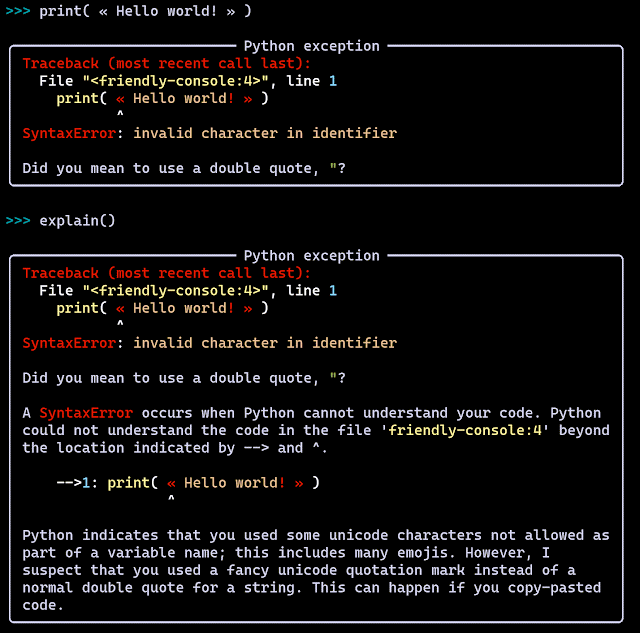
Only Python: Friendly-traceback: work in progress
It's been almost two months since my last blog post and I feel guilty of not haven't taken the time to write more regularly. I should really tell you about how fantastic Will McGugan's Rich is, and how I have customized it for my projects. I should also tell you how Sylvain Desodt's DidYouMeanPython has been influencing Friendly-traceback latest developments. Also worthy of note is how Alex Hall's FutureCoder project is incorporating so many neat tools that it feels like a real honour that he has incorporated Friendly-traceback in it.
Alas, while I have been busy making many changes and addition to the code, the documentation is hopelessly behind and no longer gives a correct picture of what Future-traceback is now capable of.
So much to do, so little time. So, I will just end with a picture, and go back to coding, with a promise of writing more ... soon I hope.
-
Python range() Function – Linux Hint
Python is a modern, general-purpose, and high-level programming language that comes with powerful features. Python has many built-in modules to support diverse operations. The range() function is a built-in function used to perform specific tasks or actions for a definite number of times. In other words, the range() function is used to perform a task iteratively. This function is used in conjunction with the for loop and the while loop.
-
Python Dictionaries – Linux Hint
Python is an efficient and versatile programming language. It is one of the most frequently used high-level programming languages to perform data-related tasks due to its many supportive built-in modules and functions. To mention some of its many built-in data structures, it has arrays, lists, tuples, etc.
Dictionaries are one of the built-in data structures in Python. It holds the data in the form of a key-value pair. The keys are the unique value that acts as a representative of data. The key is also called as “an index value”. Data structures are a very important aspect of any programming language. They are used to store and manipulate the data in a well-organized and efficient way. Therefore, Python dictionaries are more useful when we need to store the data in a form of key-value pair and to access the data faster. The Python dictionaries return the data faster because the key value for every data is unique, therefore the searching time for data is reduced, and we get the result faster. This article explicates the Python dictionaries in detail.
-
Python Classes – Linux Hint
Python is one of the multiuse high-level programming languages. It is an object-oriented programming language. The main difference between the procedural and object-oriented programming languages is that we cannot create the classes in procedural programming languages. The main focus of procedural languages is on creating functions, and variables for performing the task whereas, in object-oriented programming languages, our main concern is to create objects and use them for performing our tasks. A class is simply a blueprint that contains functions and variables. A class is like a real-life classroom of any institute. It contains some chairs, tables, desks, a projector, walls, etc. base on all these components; we build a classroom. All these components are the variables and functions in a class, and a classroom is an object. The Python classes and objects are explained in this article.
-
FreeBSD process environ and resource limits
New psutil 5.7.3 is out. This release adds support for 2 functionalities which were not available on BSD platforms: the ability to get the process environment (all BSD) and to get or set process resource limits (FreeBSD only), similarly to what can be done on Linux.
»
-

- Login or register to post comments
 Printer-friendly version
- 2199 reads
 PDF version
More in Tux Machines
- Highlights
- Front Page
- Latest Headlines
- Archive
- Recent comments
- All-Time Popular Stories
- Hot Topics
- New Members
digiKam 7.7.0 is released
After three months of active maintenance and another bug triage, the digiKam team is proud to present version 7.7.0 of its open source digital photo manager. See below the list of most important features coming with this release.
|
Dilution and Misuse of the "Linux" Brand
|
Samsung, Red Hat to Work on Linux Drivers for Future Tech
The metaverse is expected to uproot system design as we know it, and Samsung is one of many hardware vendors re-imagining data center infrastructure in preparation for a parallel 3D world.
Samsung is working on new memory technologies that provide faster bandwidth inside hardware for data to travel between CPUs, storage and other computing resources. The company also announced it was partnering with Red Hat to ensure these technologies have Linux compatibility.
|
today's howtos
|


 Content (where original) is available under CC-BY-SA, copyrighted by original author/s.



Recent comments
1 year 11 weeks ago
1 year 11 weeks ago
1 year 11 weeks ago
1 year 11 weeks ago
1 year 11 weeks ago
1 year 11 weeks ago
1 year 11 weeks ago
1 year 11 weeks ago
1 year 11 weeks ago
1 year 11 weeks ago