



Arduino and Linux in Devices/Embedded
Submitted by Rianne Schestowitz on Thursday 24th of September 2020 04:33:52 AM
Filed under 


-
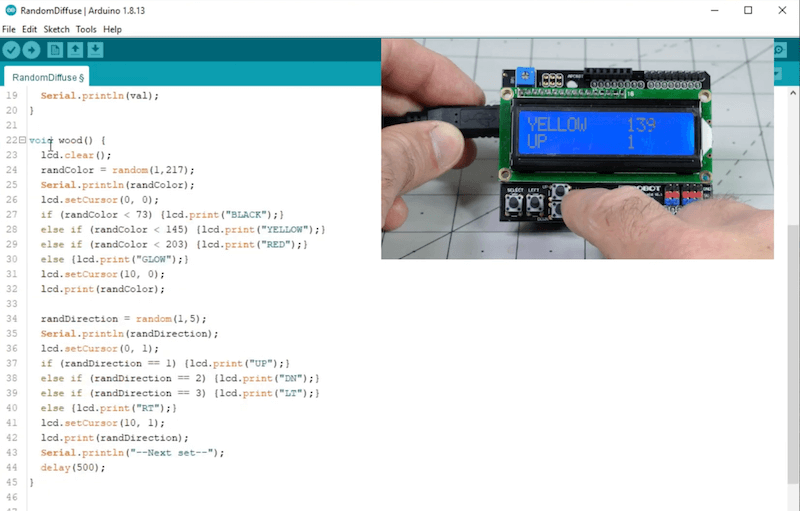
Making a random sound diffuser with Arduino
Humans are generally quite bad at coming up with random patterns, so when Jeremy Cook wanted to make a sound diffuser with angled blocks of wood, he created a “pseudorandomness console” using an Arduino Uno and an LCD shield.
[...]
Code for this unique randomization is available on GitHub, with a quick explanation in the video above. You can see the final assembly at around the 4:38 mark, showing a process of applying glue, pressing a button to generate a value, and then placing triangles accordingly.
-
Marcin 'hrw' Juszkiewicz: 8 years of my work on AArch64
Back in 2012 AArch64 was something new, unknown yet. There was no toolchain support (so no gcc, binutils or glibc). And I got assigned to get some stuff running around it.
[...]
First we had nothing. Then I added AArch64 target into OpenEmbedded.
Same month Arm released Foundation model so anyone was able to play with AArch64 system. No screen, just storage, serial and network but it was enough for some to even start building whole distributions like Debian, Fedora, OpenSUSE, Ubuntu.
At that moment several patches were shared by all distributions as it was faster way than waiting for upstreams. I saw multiple versions of some of them during my journey of fixing packages in some distributions.
-
Intel's 10nm Elkhart Lake Atom chips feature Cortex-M7 and triple 4K
Software support includes Yocto Project, Ubuntu, Wind River Linux LTS, Android 10, and Windows 10 IoT Enterprise. There is also support for Intel’s OpenVINO toolkit, with pre-optimized libraries for AI, ML, and computer vision acceleration.
-
Intel Unveils Atom x6000E Series, Celeron and Pentium Elkhart Lake IoT Edge Processors
We’ve been expecting Intel Elkhart Lake processors for more than a year, and the company has now officially announced the “IoT-enhanced processors” with a new Atom x6000E Series, as well as some Celeron and Pentium N/J parts. Last year, we thought Elkhart Lake would succeed Gemini lake, but the new 11th generation 10nm processors may not be found in many consumer devices, as they target IoT edge applications with additional artificial intelligence (AI), security, functional safety, and real-time capabilities.
-
Intel Introduces IoT-Enhanced Processors to Increase Performance, AI, Security
-
ADATA XPG GAIA MINI PC is based on the Linux-friendly Intel NUC 9 Extreme Kit
-
Ensemble Graphics Toolkit to speed Linux GUI development
Microchip has launched a GUI development toolkit for its portfolio of 32-bit microprocessors (MPUs) running Linux, helping designers of industrial, medical, consumer and automotive graphical displays to reduce development cost and time-to-market.
-
GUI toolkit for Linux enhances 32-bit microprocessor capabilities
Microchip Technology offers a new GUI development toolkit for its portfolio of 32-bit MPUs running Linux, assisting designers of industrial, medical, consumer and automotive graphical displays to lower development cost and time-to-market.
»
-

- Login or register to post comments
 Printer-friendly version
- 2303 reads
 PDF version
More in Tux Machines
- Highlights
- Front Page
- Latest Headlines
- Archive
- Recent comments
- All-Time Popular Stories
- Hot Topics
- New Members
digiKam 7.7.0 is released
After three months of active maintenance and another bug triage, the digiKam team is proud to present version 7.7.0 of its open source digital photo manager. See below the list of most important features coming with this release.
|
Dilution and Misuse of the "Linux" Brand
|
Samsung, Red Hat to Work on Linux Drivers for Future Tech
The metaverse is expected to uproot system design as we know it, and Samsung is one of many hardware vendors re-imagining data center infrastructure in preparation for a parallel 3D world.
Samsung is working on new memory technologies that provide faster bandwidth inside hardware for data to travel between CPUs, storage and other computing resources. The company also announced it was partnering with Red Hat to ensure these technologies have Linux compatibility.
|
today's howtos
|


 Content (where original) is available under CC-BY-SA, copyrighted by original author/s.



Recent comments
1 year 11 weeks ago
1 year 11 weeks ago
1 year 11 weeks ago
1 year 11 weeks ago
1 year 11 weeks ago
1 year 11 weeks ago
1 year 11 weeks ago
1 year 11 weeks ago
1 year 11 weeks ago
1 year 11 weeks ago