



Programming: OpenSCAD, Fuzzing in Go, CSS Shapes, Perl
Submitted by Roy Schestowitz on Sunday 6th of September 2020 12:21:31 PM
Filed under 
-
The programmer's CAD: OpenSCAD
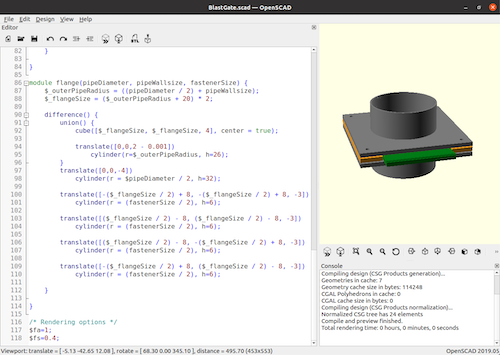
OpenSCAD is a GPLv2-licensed 3D computer-aided design (CAD) program best described as a "programmer's CAD"; it is available for Linux, Windows, several flavors of BSD, and macOS. Unlike the majority of 3D-modeling software packages which are point-and-click, the OpenSCAD website describes the project as "something like a 3D compiler", where models are generated using a scripting language. It is a unique way of approaching CAD and has many real-world applications that may be of interest.
Like the FreeCAD project we have previously looked at, OpenSCAD can be used to build 3D-models suitable for everything from 3D-printing to CNC machining. Unlike FreeCAD, however, the solitary way to create models is by programming them using the OpenSCAD scripting language. Once programmed, models produced by OpenSCAD can be exported in a variety of formats, including notably STL, SVG, and PNG.
The Qt-based interface provided by OpenSCAD is fairly simple; on one side a code editor is provided to write scripts, while the other provides a view of the generated model and a console for messages. Making a model starts with coding modules that generate primitives like cylinders and cubes, then those primitives are manipulated and combined in code to build more complicated objects. Notably, OpenSCAD is a unit-less CAD program; it leaves the units to be decided once the model is exported.
-
Fuzzing in Go
Fuzzing is a testing technique with randomized inputs that is used to find problematic edge cases or security problems in code that accepts user input. Go package developers can use Dmitry Vyukov's popular go-fuzz tool for fuzz testing their code; it has found hundreds of obscure bugs in the Go standard library as well as in third-party packages. However, this tool is not built in, and is not as simple to use as it could be; to address this, Go team member Katie Hockman recently published a draft design that proposes adding fuzz testing as a first-class feature of the standard go test command.
[...]
AFL is an excellent tool, but it only works for programs written in C, C++, or Objective C, which need to be compiled with GCC or Clang. Vyukov's go-fuzz tool operates in a similar way to AFL, but is written specifically for Go. In order to add coverage recording to a Go program, a developer first runs the go-fuzz-build command (instead of go build), which uses the built-in ast package to add instrumentation to each block in the source code, and sends the result through the regular Go compiler. Once the instrumented binary has been built, the go-fuzz command runs it over and over on multiple CPU cores with randomly mutating inputs, recording any crashes (along with their stack traces and the inputs that caused them) as it goes.
Damian Gryski has written a tutorial showing how to use the go-fuzz tool in more detail. As mentioned, the go-fuzz README lists the many bugs it has found, however, there are almost certainly many more in third-party packages that have not been listed there; I personally used go-fuzz on GoAWK and it found several "crashers".
-
Flowing Text Around Images
Traditionally this type of layout was limited to print because text that can re-flow as the medium changes sizes made it infeasible to manually add line breaks to shape the text around images.
With CSS Shapes, it’s not difficult to achieve text wrapping around an image by using the shape-outside: url() property. This directive will cause the browser to take the image’s outline and use it as the shape around which text will flow. Fortunately, shape-outside is well-supported in modern browsers and the fallback for unsupported browsers is to use a rectangle around the image as the shape, as if the image were simply floated off to the side (which it is!).
-
Sum of Individuals Gives Meaning - CY's Take on PWC#076
»
-

- Login or register to post comments
 Printer-friendly version
- 2926 reads
 PDF version
More in Tux Machines
- Highlights
- Front Page
- Latest Headlines
- Archive
- Recent comments
- All-Time Popular Stories
- Hot Topics
- New Members
digiKam 7.7.0 is released
After three months of active maintenance and another bug triage, the digiKam team is proud to present version 7.7.0 of its open source digital photo manager. See below the list of most important features coming with this release.
|
Dilution and Misuse of the "Linux" Brand
|
Samsung, Red Hat to Work on Linux Drivers for Future Tech
The metaverse is expected to uproot system design as we know it, and Samsung is one of many hardware vendors re-imagining data center infrastructure in preparation for a parallel 3D world.
Samsung is working on new memory technologies that provide faster bandwidth inside hardware for data to travel between CPUs, storage and other computing resources. The company also announced it was partnering with Red Hat to ensure these technologies have Linux compatibility.
|
today's howtos
|


 Content (where original) is available under CC-BY-SA, copyrighted by original author/s.



Recent comments
1 year 11 weeks ago
1 year 11 weeks ago
1 year 11 weeks ago
1 year 11 weeks ago
1 year 11 weeks ago
1 year 11 weeks ago
1 year 11 weeks ago
1 year 11 weeks ago
1 year 11 weeks ago
1 year 11 weeks ago