



Release notes for the Genode OS Framework 20.08
Submitted by Roy Schestowitz on Monday 31st of August 2020 04:21:01 AM
Filed under 
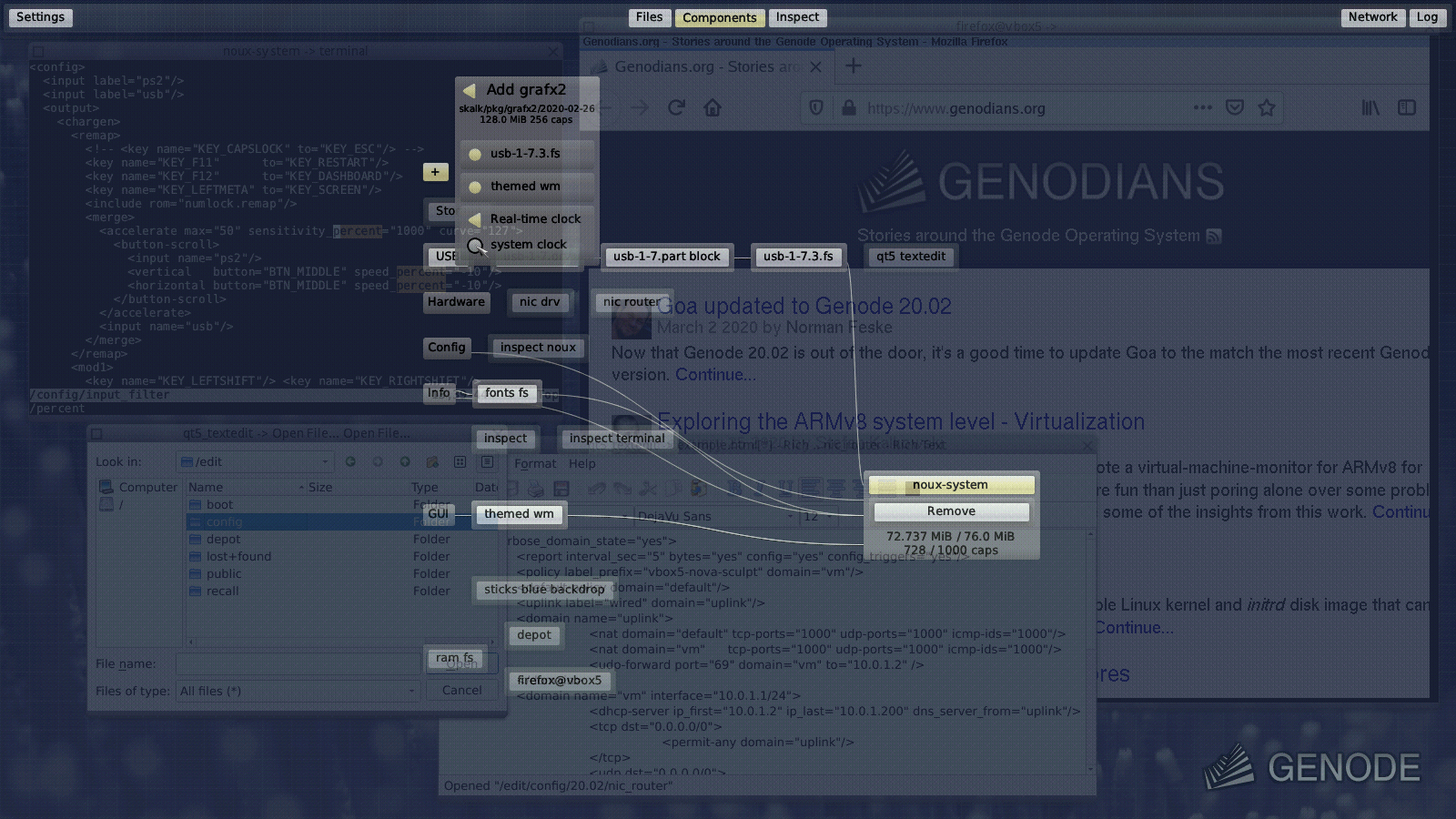
There are two overarching themes of Genode version 20.08: Increasing the weight of native work loads, and strengthening the system's resilience against driver failures.
With native work loads, we are speaking of software executed directly on Genode without relying on virtual machines. Compared to static systems or hypervisor scenarios, such work loads are brutally unforgiving when it comes to the quality of the POSIX runtime, the performance of Genode's protocol stacks, and the economics of the porting of software. By bringing the Chromium web engine alive, we expose Genode to one of the most heavy-weight commodity software stacks in existence. We are thrilled to report in Section Improved Qt5 integration and work flows that the Chromium-based Falkon web browser can be hosted on Sculpt OS now. The collateral effects of this work are at least as valuable as the particular application: Improved work flows for porting large software projects, and covering many formerly hidden corner cases of the C and C++ runtimes.
With Sculpt OS, the resilience of Genode in the event of failing graphics or input drivers came into focus. Section The GUI stack, restacked describes a complex surgery that puts the low-level GUI stack upside down, paving the ground for exciting features like swapping out or updating drivers on the fly without reboot.

Also: Genode OS 20.08 Has Chromium Web Engine Running, Low-Level GUI Work
»
-

- Login or register to post comments
 Printer-friendly version
- 3003 reads
 PDF version
More in Tux Machines
- Highlights
- Front Page
- Latest Headlines
- Archive
- Recent comments
- All-Time Popular Stories
- Hot Topics
- New Members
digiKam 7.7.0 is released
After three months of active maintenance and another bug triage, the digiKam team is proud to present version 7.7.0 of its open source digital photo manager. See below the list of most important features coming with this release.
|
Dilution and Misuse of the "Linux" Brand
|
Samsung, Red Hat to Work on Linux Drivers for Future Tech
The metaverse is expected to uproot system design as we know it, and Samsung is one of many hardware vendors re-imagining data center infrastructure in preparation for a parallel 3D world.
Samsung is working on new memory technologies that provide faster bandwidth inside hardware for data to travel between CPUs, storage and other computing resources. The company also announced it was partnering with Red Hat to ensure these technologies have Linux compatibility.
|
today's howtos
|


 Content (where original) is available under CC-BY-SA, copyrighted by original author/s.



Recent comments
1 year 11 weeks ago
1 year 11 weeks ago
1 year 11 weeks ago
1 year 11 weeks ago
1 year 11 weeks ago
1 year 11 weeks ago
1 year 11 weeks ago
1 year 11 weeks ago
1 year 11 weeks ago
1 year 11 weeks ago