



HBO Max cranks up the Widevine DRM, leaves Linux users in the cold
Submitted by Roy Schestowitz on Thursday 27th of August 2020 01:29:41 AM
Filed under 

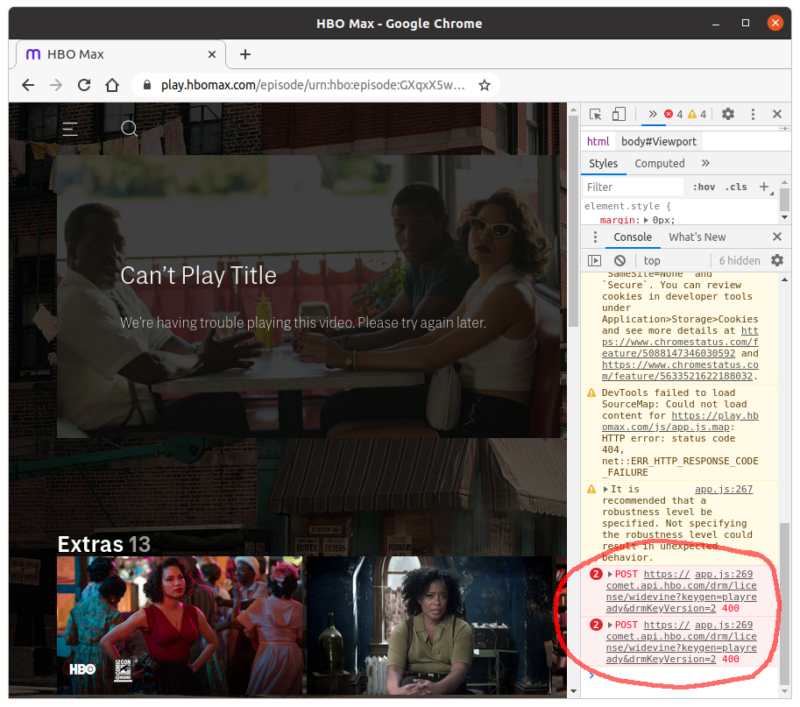
Unfortunately, trying again later won't help—the root cause of the problem is that the Widevine DRM attempting to protect HBO Max's content from pirates is refusing to recognize any Linux system as a known platform. We saw the same thing happen in January, when CBS All Access suddenly stopped working on Linux in the same way. When we asked CBS executives if they had enabled the Verified Media Path (VMP) requirement on their Widevine server, they suddenly clammed up—but later that day, the service miraculously worked for Linux users again.
We did verify that HBO Max will not work on Linux browsers and that the problem is—once again—Widevine DRM refusing to issue a license. Although HBO Max has not returned requests for comment at press time, it seems very likely that the cause here is the same as it was for CBS All Access back in January. It seems like somebody enabled Verified Media Path on the Widevine server, and since the Linux kernel is not a verified media path, Linux users can't get a license and can't watch the content.
We're hopeful that once HBO Max gets the word that this decision locked out a small percentage of their users—and getting them back is as simple as toggling an option "off" again—they'll get their Linux users back online, just as CBS did back in January. We'll update here if and when we hear back from HBO Max executives, or if the situation otherwise changes for their Linux users.

»
-

- Login or register to post comments
 Printer-friendly version
- 3927 reads
 PDF version
More in Tux Machines
- Highlights
- Front Page
- Latest Headlines
- Archive
- Recent comments
- All-Time Popular Stories
- Hot Topics
- New Members
digiKam 7.7.0 is released
After three months of active maintenance and another bug triage, the digiKam team is proud to present version 7.7.0 of its open source digital photo manager. See below the list of most important features coming with this release.
|
Dilution and Misuse of the "Linux" Brand
|
Samsung, Red Hat to Work on Linux Drivers for Future Tech
The metaverse is expected to uproot system design as we know it, and Samsung is one of many hardware vendors re-imagining data center infrastructure in preparation for a parallel 3D world.
Samsung is working on new memory technologies that provide faster bandwidth inside hardware for data to travel between CPUs, storage and other computing resources. The company also announced it was partnering with Red Hat to ensure these technologies have Linux compatibility.
|
today's howtos
|


 Content (where original) is available under CC-BY-SA, copyrighted by original author/s.



Recent comments
1 year 11 weeks ago
1 year 11 weeks ago
1 year 11 weeks ago
1 year 11 weeks ago
1 year 11 weeks ago
1 year 11 weeks ago
1 year 11 weeks ago
1 year 11 weeks ago
1 year 11 weeks ago
1 year 11 weeks ago