



Will Thompson: Bustleman’s Holiday
Submitted by Roy Schestowitz on Monday 17th of August 2020 02:08:53 AM
Filed under 
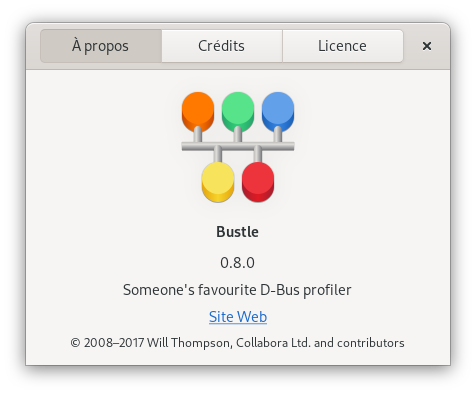
The main user-facing change is a great new icon, designed and drawn by Tobias Bernard. (Unfortunately the Flathub website still shows the old one for CDN cache reasons, but you can feast your eyes above or in your favourite app centre.)
I also rewrote some parts of the app from Haskell to C. In particular, it no longer uses the Haskell D-Bus implementation and libpcap binding, instead using GDBus and GVariant (via some minimal hand-written FFI bindings) and some mostly-existing C code, respectively. Me circa 2008 would be horrified to learn that I’ve done this, and me circa 2020 is sad to be introducing more unsafe code, but the net result is a smaller app with way fewer transitive dependencies.
Why can’t it use GDBus via GObject Introspection, you ask? GLib didn’t have a D-Bus implementation in 2008, and there was no GObject Introspection support for Haskell. These days, bindings for Gio etc. generated via GObject Introspection exist, but migrating Bustle to these would amount to a rewrite, and I don’t have the time or stomach for that. (These libraries all have my name on them because I made a small start at the generator back in 2011 with the express goal of using them in Bustle, but I’d be amazed if any of my work is still present.)

»
-

- Login or register to post comments
 Printer-friendly version
- 1960 reads
 PDF version
More in Tux Machines
- Highlights
- Front Page
- Latest Headlines
- Archive
- Recent comments
- All-Time Popular Stories
- Hot Topics
- New Members
digiKam 7.7.0 is released
After three months of active maintenance and another bug triage, the digiKam team is proud to present version 7.7.0 of its open source digital photo manager. See below the list of most important features coming with this release.
|
Dilution and Misuse of the "Linux" Brand
|
Samsung, Red Hat to Work on Linux Drivers for Future Tech
The metaverse is expected to uproot system design as we know it, and Samsung is one of many hardware vendors re-imagining data center infrastructure in preparation for a parallel 3D world.
Samsung is working on new memory technologies that provide faster bandwidth inside hardware for data to travel between CPUs, storage and other computing resources. The company also announced it was partnering with Red Hat to ensure these technologies have Linux compatibility.
|
today's howtos
|


 Content (where original) is available under CC-BY-SA, copyrighted by original author/s.



Recent comments
1 year 11 weeks ago
1 year 11 weeks ago
1 year 11 weeks ago
1 year 11 weeks ago
1 year 11 weeks ago
1 year 11 weeks ago
1 year 11 weeks ago
1 year 11 weeks ago
1 year 11 weeks ago
1 year 11 weeks ago