



Linux Mint Monthly News and Ubuntu Leftovers
Submitted by Roy Schestowitz on Friday 31st of July 2020 09:43:51 PM
Filed under 
-
Linux Mint Monthly News – July 2020
I’d like to thank you all for your support. Donations are usually quite high after a release and Linux Mint 20 is no exception. We received 924 donations in a single month! That’s quite an impressive number and it makes us feel really proud, both as a project and a community.
Linux Mint 20 was well received but it introduced new challenges, both as a release and an upgrade. We’ll be focused on tackling these challenges for the next two years as well as implementing exciting refinements and new features in the upcoming point releases. Some of these are already listed on our Trello boards and roadmaps. I’d rather talk about them once they’re implemented and ready to be shipped though. Hopefully this time next month we’ll be able to give you a preview of some of them.
In last month’s feedback we noted some users would like Linux Mint to package Chromium. We also observed confusion and lack of empowerment when it comes to dealing with foreign packages during the upgrade. These are two areas we’re looking into at the moment.
LMDE 4 received many updates lately, including the new features from Linux Mint 20 and Cinnamon 4.6.
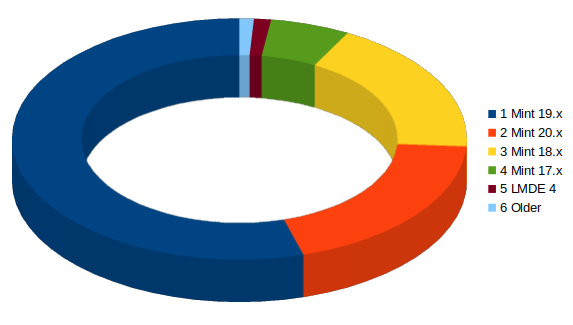
A study on the popularity of Linux Mint releases showed some interested results and comforted some of the perception we had of our user base.
-
Charmed OSM Release EIGHT available from Canonical
Canonical is proud to announce the general availability of OSM release EIGHT images in it’s Charmed OSM distribution. As of Release SEVEN, OSM is able to orchestrate containerised network functions (CNFs) leveraging Kubernetes as the underlying infrastructure for next-generation 5G services. Release EIGHT follows the same direction and brings new features that allow for the orchestration of a broader range of network functions and production environments.
Open Source MANO (OSM) Release EIGHT is the result of great community work in a project that drives the most complete open source network function virtualisation (NFV) orchestrator in the market.
-
Full Circle Magazine #159
This month:
* Command & Conquer
* How-To : Python, Podcast Production, and Rawtherapee
* Graphics : Inkscape
* Graphics : Krita for Old Photos
* Linux Loopback
* Everyday Ubuntu
* Ubports Touch
* Review : Ubuntu Unity 20.04
* Ubuntu Games : Mable And The Wood
plus: News, My Opinion, The Daily Waddle, Q&A, and more.
»
-

- Login or register to post comments
 Printer-friendly version
- 5481 reads
 PDF version
More in Tux Machines
- Highlights
- Front Page
- Latest Headlines
- Archive
- Recent comments
- All-Time Popular Stories
- Hot Topics
- New Members
digiKam 7.7.0 is released
After three months of active maintenance and another bug triage, the digiKam team is proud to present version 7.7.0 of its open source digital photo manager. See below the list of most important features coming with this release.
|
Dilution and Misuse of the "Linux" Brand
|
Samsung, Red Hat to Work on Linux Drivers for Future Tech
The metaverse is expected to uproot system design as we know it, and Samsung is one of many hardware vendors re-imagining data center infrastructure in preparation for a parallel 3D world.
Samsung is working on new memory technologies that provide faster bandwidth inside hardware for data to travel between CPUs, storage and other computing resources. The company also announced it was partnering with Red Hat to ensure these technologies have Linux compatibility.
|
today's howtos
|


 Content (where original) is available under CC-BY-SA, copyrighted by original author/s.



Recent comments
1 year 11 weeks ago
1 year 11 weeks ago
1 year 11 weeks ago
1 year 11 weeks ago
1 year 11 weeks ago
1 year 11 weeks ago
1 year 11 weeks ago
1 year 11 weeks ago
1 year 11 weeks ago
1 year 11 weeks ago