



Linux on Laptops: ASUS Zephyrus G14 with Ryzen 9 4900HS
Submitted by Rianne Schestowitz on Friday 10th of April 2020 01:50:21 PM
Filed under 


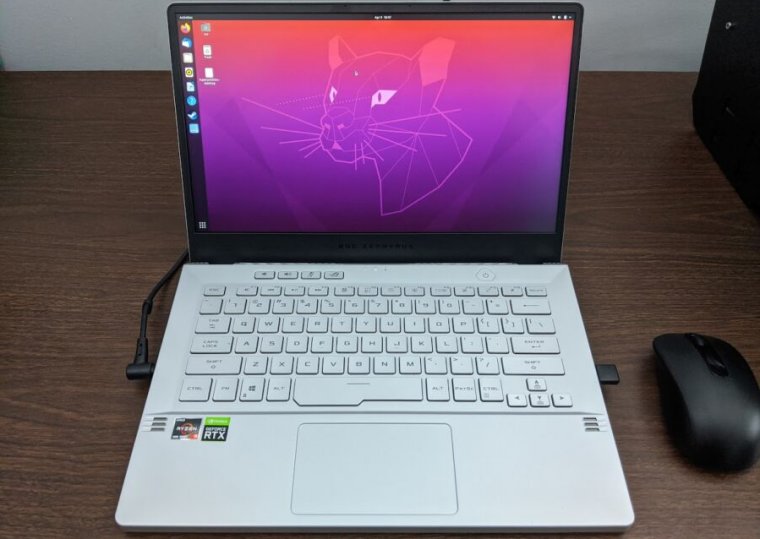
It looks like the Zephyrus G14 is a bust under Linux, at least for now. It might be possible to get it working better than I did here, but it'll take a considerable amount of work, at the very least.
Get used to fan noise. A lot of fan noise. While the fans mostly only kicked into high gear for gaming under Windows, under Linux they just get feisty for no apparent reason. If you haven't read our Windows review of this laptop, they're quite loud, even for a gaming laptop.
It wasn't too much trouble to get the G14 to boot Ubuntu 20.04, or to get it mostly functional. But with a touchpad that only works occasionally, no support for either GPU, and only a couple of hours on-battery while watching videos, for now it's not much more than a curiosity.
The only bright spot in this dark and dismal painting is the Ryzen 9 4900HS itself. I didn't do any real CPU benchmarking—but bumblebee is a DKMS module, so I got to see how the 4900HS handled compiling it from source. I initially thought the kernel headers weren't installed, and it hadn't compiled the module at all—but they were, and it did. The CPU is just that beefy.
Full disclosure—this was my first attempt to wrestle a dual-GPU laptop into submission, so I may have missed some tricks. If you spot something that I should have tried but didn't, please pipe up in the comments.

»
-

- Login or register to post comments
 Printer-friendly version
- 5346 reads
 PDF version
More in Tux Machines
- Highlights
- Front Page
- Latest Headlines
- Archive
- Recent comments
- All-Time Popular Stories
- Hot Topics
- New Members
digiKam 7.7.0 is released
After three months of active maintenance and another bug triage, the digiKam team is proud to present version 7.7.0 of its open source digital photo manager. See below the list of most important features coming with this release.
|
Dilution and Misuse of the "Linux" Brand
|
Samsung, Red Hat to Work on Linux Drivers for Future Tech
The metaverse is expected to uproot system design as we know it, and Samsung is one of many hardware vendors re-imagining data center infrastructure in preparation for a parallel 3D world.
Samsung is working on new memory technologies that provide faster bandwidth inside hardware for data to travel between CPUs, storage and other computing resources. The company also announced it was partnering with Red Hat to ensure these technologies have Linux compatibility.
|
today's howtos
|


 Content (where original) is available under CC-BY-SA, copyrighted by original author/s.



Recent comments
1 year 11 weeks ago
1 year 11 weeks ago
1 year 11 weeks ago
1 year 11 weeks ago
1 year 11 weeks ago
1 year 11 weeks ago
1 year 11 weeks ago
1 year 11 weeks ago
1 year 11 weeks ago
1 year 11 weeks ago