



A Linux Performance Look At AMD's 64-core Ryzen Threadripper 3990X Processor
Submitted by Roy Schestowitz on Thursday 5th of March 2020 03:31:44 AM
Filed under 

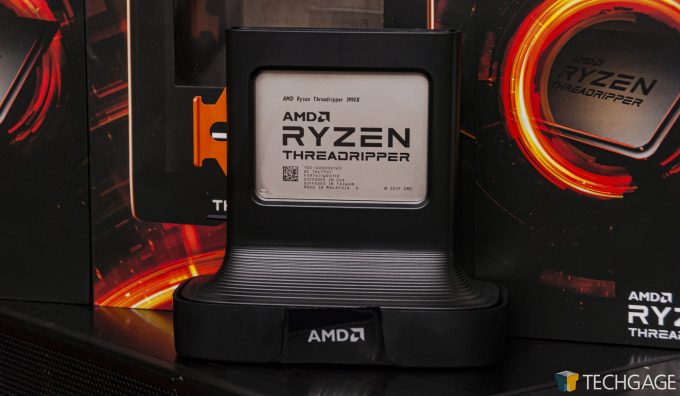
Our Linux configuration is simple overall. We’re using the latest version of Ubuntu (19.10) for our testing, which is fully updated, and upgraded to the 5.5 kernel. Out-of-the-box, Ubuntu 19.10 can’t boot on the latest Threadripper platform without the ‘mce=off’ boot flag, but once upgraded to the 5.5 kernel, that problem goes away.
Many of our tests are run with the help of Phoronix Test Suite, with tests locked to a specific version to generate repeatedly reliable data. We don’t do any real OS configuration outside of disabling sleep, and enforcing the performance power profile.
On AMD platforms, XMP is enabled, and that’s all that’s touched. There is no automatic overclocking performed by the EFIs on these platforms, as far as we can tell (when compared to reviewer guide performance). On the Intel platforms using ASUS, XMP is enabled, and “Yes” is chosen to let it optimize the settings, after which point the Turbo boost settings are reverted to Intel default behavior. This ensures proper memory timings and settings are enabled, and that no automatic overclock will take place.
All of the platforms we tested on had their EFI updated before testing, if one was available. While the current EFI available for our tested ASUS Zenith II Extreme from ASUS’ website will handle the 3990X no problem, we upgraded to an internal beta for this review, as it was expected to deliver better stability with DDR4-3600 memory.

»
-

- Login or register to post comments
 Printer-friendly version
- 2308 reads
 PDF version
More in Tux Machines
- Highlights
- Front Page
- Latest Headlines
- Archive
- Recent comments
- All-Time Popular Stories
- Hot Topics
- New Members
digiKam 7.7.0 is released
After three months of active maintenance and another bug triage, the digiKam team is proud to present version 7.7.0 of its open source digital photo manager. See below the list of most important features coming with this release.
|
Dilution and Misuse of the "Linux" Brand
|
Samsung, Red Hat to Work on Linux Drivers for Future Tech
The metaverse is expected to uproot system design as we know it, and Samsung is one of many hardware vendors re-imagining data center infrastructure in preparation for a parallel 3D world.
Samsung is working on new memory technologies that provide faster bandwidth inside hardware for data to travel between CPUs, storage and other computing resources. The company also announced it was partnering with Red Hat to ensure these technologies have Linux compatibility.
|
today's howtos
|


 Content (where original) is available under CC-BY-SA, copyrighted by original author/s.



Recent comments
1 year 11 weeks ago
1 year 11 weeks ago
1 year 11 weeks ago
1 year 11 weeks ago
1 year 11 weeks ago
1 year 11 weeks ago
1 year 11 weeks ago
1 year 11 weeks ago
1 year 11 weeks ago
1 year 11 weeks ago