



The sad case of Unreal Engine 1 on Mesa and Linux in 2020
Submitted by Roy Schestowitz on Tuesday 4th of February 2020 11:37:43 PM
Filed under 
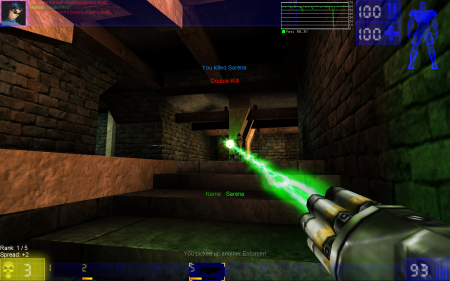
One of the great game industry battles of the turn of century was the standoff between Quake III Arena and Unreal Tournament. With both multiplayer focused first person shooters released just weeks apart from one another, that the two games would wind up going head to head was inevitable. If pressed I am always going to have to say I favour the former, but the remarkable thing for us Linux users is that, for a time, both games lived harmoniously under the same publisher.
More than any other developer, Loki Software can be credited with founding the Linux games industry, and with them still riding high at the time, they went on to publish both titles on our platform. More than just popular games, Quake III Arena and Unreal Tournament were also flagships for the engine technology within. Unreal Engine 1 and id Tech 3 would go on to be used in dozens of other titles, some of which would also be ported by Loki Software before their closure in 2002.
While Quake III Arena was granted its place in eternity when its source code was released in 2005, community support for Unreal Tournament was able to breathe some new life into the game, even with the limitations of the closed binary. By 2018 however the game was no longer launching for Mesa users. Due to the Core.so file being statically linked to an archaic libstdc++ library, the game can only be ran outside of Software mode on the free graphics stack with use of a hacked Mesa patch.

»
-

- Login or register to post comments
 Printer-friendly version
- 1973 reads
 PDF version
More in Tux Machines
- Highlights
- Front Page
- Latest Headlines
- Archive
- Recent comments
- All-Time Popular Stories
- Hot Topics
- New Members
digiKam 7.7.0 is released
After three months of active maintenance and another bug triage, the digiKam team is proud to present version 7.7.0 of its open source digital photo manager. See below the list of most important features coming with this release.
|
Dilution and Misuse of the "Linux" Brand
|
Samsung, Red Hat to Work on Linux Drivers for Future Tech
The metaverse is expected to uproot system design as we know it, and Samsung is one of many hardware vendors re-imagining data center infrastructure in preparation for a parallel 3D world.
Samsung is working on new memory technologies that provide faster bandwidth inside hardware for data to travel between CPUs, storage and other computing resources. The company also announced it was partnering with Red Hat to ensure these technologies have Linux compatibility.
|
today's howtos
|


 Content (where original) is available under CC-BY-SA, copyrighted by original author/s.



Recent comments
1 year 11 weeks ago
1 year 11 weeks ago
1 year 11 weeks ago
1 year 11 weeks ago
1 year 11 weeks ago
1 year 11 weeks ago
1 year 11 weeks ago
1 year 11 weeks ago
1 year 11 weeks ago
1 year 11 weeks ago