



Give an old MacBook new life with Linux
Submitted by Rianne Schestowitz on Monday 3rd of February 2020 09:11:25 AM
Filed under 
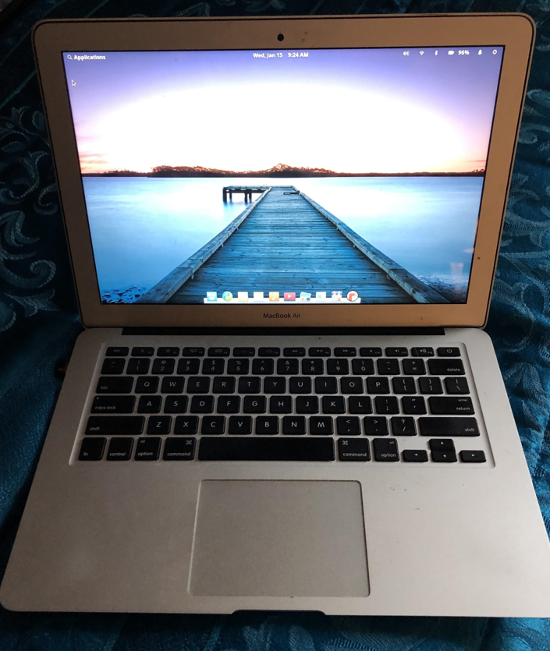
When I installed Apple's MacOS Mojave, it slowed my formerly reliable MacBook Air to a crawl. My computer, released in 2015, has 4GB RAM, an i5 processor, and a Broadcom 4360 wireless card, but Mojave proved too much for my daily driver—it made working with GnuCash impossible, and it whetted my appetite to return to Linux. I am glad I did, but I felt bad that I had this perfectly good MacBook lying around unused.
I tried several Linux distributions on my MacBook Air, but there was always a gotcha. Sometimes it was the wireless card; another time, it was a lack of support for the touchpad. After reading some good reviews, I decided to try Elementary OS 5.0 (Juno). I made a boot drive with my USB creator and inserted it into the MacBook Air. I got to a live desktop, and the operating system recognized my Broadcom wireless chipset—I thought this just might work!
I liked what I saw in Elementary OS; its Pantheon desktop is really great, and its look and feel are familiar to Apple users—it has a dock at the bottom of the display and icons that lead to useful applications. I liked the preview of what I could expect, so I decided to install it—and then my wireless disappeared. That was disappointing. I really liked Elementary OS, but no wireless is a non-starter.

»
-

- Login or register to post comments
 Printer-friendly version
- 2240 reads
 PDF version
More in Tux Machines
- Highlights
- Front Page
- Latest Headlines
- Archive
- Recent comments
- All-Time Popular Stories
- Hot Topics
- New Members
digiKam 7.7.0 is released
After three months of active maintenance and another bug triage, the digiKam team is proud to present version 7.7.0 of its open source digital photo manager. See below the list of most important features coming with this release.
|
Dilution and Misuse of the "Linux" Brand
|
Samsung, Red Hat to Work on Linux Drivers for Future Tech
The metaverse is expected to uproot system design as we know it, and Samsung is one of many hardware vendors re-imagining data center infrastructure in preparation for a parallel 3D world.
Samsung is working on new memory technologies that provide faster bandwidth inside hardware for data to travel between CPUs, storage and other computing resources. The company also announced it was partnering with Red Hat to ensure these technologies have Linux compatibility.
|
today's howtos
|


 Content (where original) is available under CC-BY-SA, copyrighted by original author/s.



Recent comments
1 year 11 weeks ago
1 year 11 weeks ago
1 year 11 weeks ago
1 year 11 weeks ago
1 year 11 weeks ago
1 year 11 weeks ago
1 year 11 weeks ago
1 year 11 weeks ago
1 year 11 weeks ago
1 year 11 weeks ago