



Analyzing Distrowatch Trends
Submitted by Rianne Schestowitz on Monday 16th of December 2019 01:15:24 PM
Filed under 
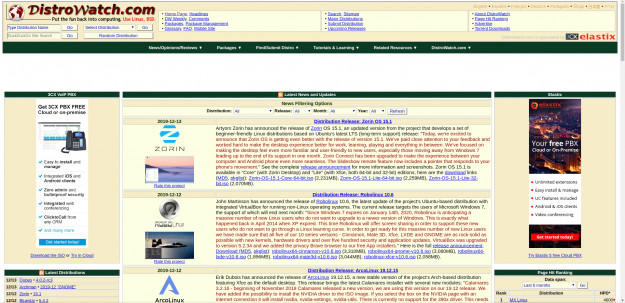
Free software is so diverse that its trends are hard to follow. How can information be gathered without tremendous effort and expense? Recently, it occurred to me that a very general sense of free software trends can be had by using the search page on Distrowatch. Admittedly, it is not a very exact sense — it is more like the sparklines on a spreadsheet that show general trends rather the details. Still, the results are suggestive.
As you probably know, Distrowatch has been tracking Linux distributions since 2002. It is best-known for its page hit rankings for distributions. These rankings do not show how many people are actually using each distro, but the interest in each distro. Still, this interest often does seem to be a broad indicator. For instance, in the last few years Ubuntu has slipped from the top ranking that it held for years to its current position of fifth, which does seem to bear some resemblance to its popularity today.
However, Distrowatch’s search page for distributions is less well-known. Hidden in the home page header, the search function includes filters for such useful information as the version of packages, init software, and what derivatives a distro might have, and lists matching distros in order of popularity. Although I have heard complaints that Distrowatch can be slow to add or update the distros listed, it occurs to me that the number of results indicates general trends. The results could not be plausibly used to suggest that a difference of one or two results was signficant, but greater differences are likely to be more significant.

»
-

- Login or register to post comments
 Printer-friendly version
- 2780 reads
 PDF version
More in Tux Machines
- Highlights
- Front Page
- Latest Headlines
- Archive
- Recent comments
- All-Time Popular Stories
- Hot Topics
- New Members
digiKam 7.7.0 is released
After three months of active maintenance and another bug triage, the digiKam team is proud to present version 7.7.0 of its open source digital photo manager. See below the list of most important features coming with this release.
|
Dilution and Misuse of the "Linux" Brand
|
Samsung, Red Hat to Work on Linux Drivers for Future Tech
The metaverse is expected to uproot system design as we know it, and Samsung is one of many hardware vendors re-imagining data center infrastructure in preparation for a parallel 3D world.
Samsung is working on new memory technologies that provide faster bandwidth inside hardware for data to travel between CPUs, storage and other computing resources. The company also announced it was partnering with Red Hat to ensure these technologies have Linux compatibility.
|
today's howtos
|


 Content (where original) is available under CC-BY-SA, copyrighted by original author/s.



Recent comments
1 year 11 weeks ago
1 year 11 weeks ago
1 year 11 weeks ago
1 year 11 weeks ago
1 year 11 weeks ago
1 year 11 weeks ago
1 year 11 weeks ago
1 year 11 weeks ago
1 year 11 weeks ago
1 year 11 weeks ago