



Chrome OS update will allow higher-end Chromebooks to use more memory for Linux
Submitted by Rianne Schestowitz on Thursday 24th of October 2019 06:30:10 PM
Filed under 

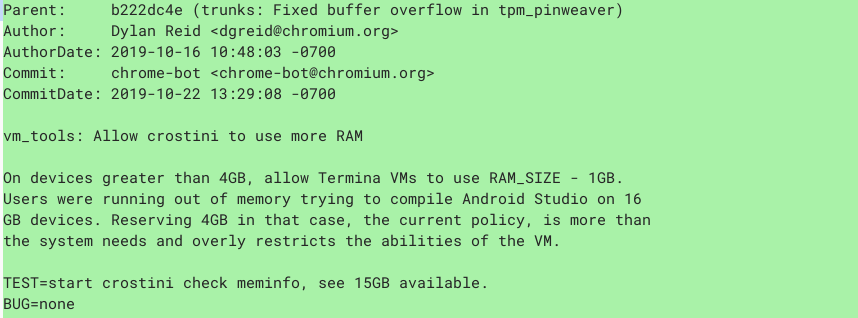
Here’s an interesting Chrome OS change coming up considering that I now use a Chromebook with 16 GB of RAM: A new code commit will change how memory is allocated to the Linux environment on Chromebooks with more than 4 GB of RAM. Those devices will see more memory provided to the Linux container…. a lot more, as it stands now.
The code commit description says it all and I was surprised to see that if you have more than 4 GB of memory in your Chromebook, all but 1 GB of it will go towards Linux.
I understand the specific reason noted above that would require this memory allocation change. But it seems a bit excessive when it comes to running Linux on a Chromebook with more than 4 GB of memory. Or rather, it seems like leaving just a single GB of RAM to run Chrome OS on such a device feels too limiting.
What I’d prefer to see (if anyone on the Chromium team cares about my opinion!) is a memory allocation slider in the Linux settings within Chrome OS. This way, I could choose to allocate, for example, 4 GB of memory to Chrome OS and 12 GB to the Linux container on my Acer Chromebook Spin 13 with 16 GB of memory, prior to starting up a new Linux container.

»
-

- Login or register to post comments
 Printer-friendly version
- 2583 reads
 PDF version
More in Tux Machines
- Highlights
- Front Page
- Latest Headlines
- Archive
- Recent comments
- All-Time Popular Stories
- Hot Topics
- New Members
digiKam 7.7.0 is released
After three months of active maintenance and another bug triage, the digiKam team is proud to present version 7.7.0 of its open source digital photo manager. See below the list of most important features coming with this release.
|
Dilution and Misuse of the "Linux" Brand
|
Samsung, Red Hat to Work on Linux Drivers for Future Tech
The metaverse is expected to uproot system design as we know it, and Samsung is one of many hardware vendors re-imagining data center infrastructure in preparation for a parallel 3D world.
Samsung is working on new memory technologies that provide faster bandwidth inside hardware for data to travel between CPUs, storage and other computing resources. The company also announced it was partnering with Red Hat to ensure these technologies have Linux compatibility.
|
today's howtos
|


 Content (where original) is available under CC-BY-SA, copyrighted by original author/s.



Recent comments
1 year 11 weeks ago
1 year 11 weeks ago
1 year 11 weeks ago
1 year 11 weeks ago
1 year 11 weeks ago
1 year 11 weeks ago
1 year 11 weeks ago
1 year 11 weeks ago
1 year 11 weeks ago
1 year 11 weeks ago