



IDAD 2019: Join us on October 12th, and use this special dust jacket to uphold the right to read
Submitted by Roy Schestowitz on Friday 11th of October 2019 02:27:03 AM
Filed under 
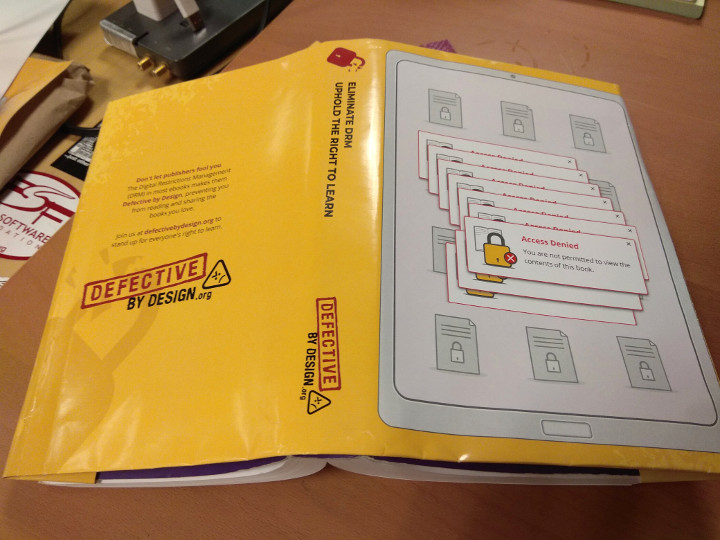
Each year we stage the International Day Against DRM (IDAD) to help others learn about the dangers of Digital Restrictions Management (DRM). For this year's IDAD on October 12th, we are focusing in particular on the increasing and disturbing amount of DRM present in ebooks and other online educational materials. Having so thoroughly invaded our leisure time, the digital infection known as DRM should not be allowed to spread into the classroom. Joining us in the fight for IDAD 2019 are the Electronic Frontier Foundation, Creative Commons, and The Document Foundation, among ten other participating organizations we are privileged to have standing with us in the fight against DRM.
In a bid to become the "Netflix of textbooks," and like many other publishers, Pearson is doing the opposite of what anyone committed to education should do: severely restricting a student's access to the materials they need for their courses through arbitrary page limits, "rented" books that disappear, and many which require a constant Internet connection.
Publishers like Pearson should not be allowed to decide the rigidly specific conditions under which a student can learn. No book should spy on your reading habits or simply "disappear" after you have had it for too long. In the digital age, it is unacceptable for a publisher to impose the same principles of scarcity that would apply to a physical product to a digital file. The computing revolution was caused by files being shared, not merely rented. Imposing these limitations on digital media is an attack on user freedom, no matter how much corporate PR may spin the story. It's our aim to let the world know that we support the rights of readers. You could say that for IDAD 2019, Defective by Design has you covered.

»
-

- Login or register to post comments
 Printer-friendly version
- 1462 reads
 PDF version
More in Tux Machines
- Highlights
- Front Page
- Latest Headlines
- Archive
- Recent comments
- All-Time Popular Stories
- Hot Topics
- New Members
digiKam 7.7.0 is released
After three months of active maintenance and another bug triage, the digiKam team is proud to present version 7.7.0 of its open source digital photo manager. See below the list of most important features coming with this release.
|
Dilution and Misuse of the "Linux" Brand
|
Samsung, Red Hat to Work on Linux Drivers for Future Tech
The metaverse is expected to uproot system design as we know it, and Samsung is one of many hardware vendors re-imagining data center infrastructure in preparation for a parallel 3D world.
Samsung is working on new memory technologies that provide faster bandwidth inside hardware for data to travel between CPUs, storage and other computing resources. The company also announced it was partnering with Red Hat to ensure these technologies have Linux compatibility.
|
today's howtos
|


 Content (where original) is available under CC-BY-SA, copyrighted by original author/s.



Recent comments
1 year 11 weeks ago
1 year 11 weeks ago
1 year 11 weeks ago
1 year 11 weeks ago
1 year 11 weeks ago
1 year 11 weeks ago
1 year 11 weeks ago
1 year 11 weeks ago
1 year 11 weeks ago
1 year 11 weeks ago