



False Accusations Against Linux Security Continue
Submitted by Roy Schestowitz on Friday 27th of September 2019 04:01:18 AM
Filed under 


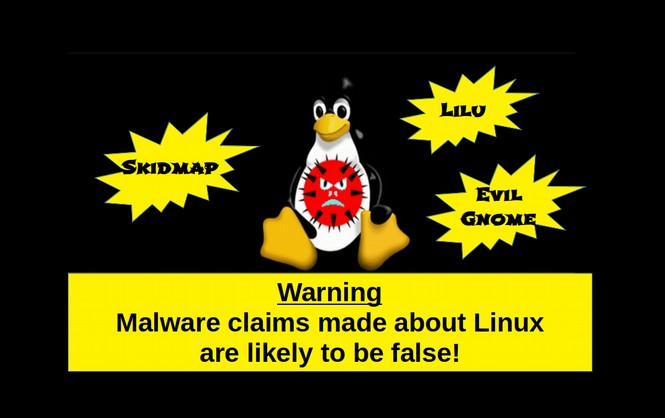
For the past two years, ever since the release of dozens of NSA created Windows hacking tools in 2017, there have been an ever increasing wave of ransomware attacks against Windows computers. During this time, I have written several articles explaining in detail how hackers use hidden back doors in the Windows operating system to take over and lock up Windows computers. I ended each of these articles by urging folks to protect their data by replacing the poorly designed Windows operating system with the free and much more secure Linux operating system as this is really the only way to protect your computer, your data and your business from a ransomware attack.
It is surprising that despite these ever increasing Windows Ransomware attacks, the value of Microsoft stock has continued to increase to the point where Microsoft is now a trillion dollar corporation. I understand that Microsoft spends billions of dollars on marketing and promoting itself. But one would think that eventually the truth would come out that Windows is not a secure operating system. However, instead of exposing the truth about Windows Security Flaws, the corporate media is engaged in a relentless campaign of making a series of false accusations against Linux claiming that Linux also suffers from security problems.
[...]
Trend Micro is a Microsoft “Gold Partner.” None of the so-called news articles that repeated the Skidmap hoax note either of these facts. But I think it is relevant when it comes to assessing their credibility.
Now for the actual allegations. The headline for all of these articles is some version of the following: “Skidmap Linux Malware Uses Rootkit Capabilities to Hide Cryptocurrency Mining”
This sounds very high tech. The reader is likely to know that Cryptocurrency Mining is Bit Coin Mining. You likely have heard that hackers can and do take over Windows computers all the time and use them for Bitcoin mining. So if hackers can do this to Windows computers, it seems at least plausible that hackers could also take over Linux computers and use them for bitcoin mining. This only sounds plausible because most readers have no idea that there are huge differences between the security of Linux computers versus the lack of security of Windows computers.
[...]
By default, there aren’t any crontab jobs on any Linux computer. In fact, you would need to authorize the addition of any tasks by entering your root user password.
This is an example of the difference between Windows and Linux. Windows puts Microsoft in control of your updates through automatic updates remotely controlled by Microsoft (and whatever hackers also know about this backdoor and use it to remotely control your computer - while Linux puts you in control of your updates and all other changes on your computer. Hopefully, you can see now why the Trend Micro claim is complete and utter nonsense.
[...]
These are not Russian hackers. They do have a Command and Control Center. But it is not located in Moscow. Instead, it is located in Virginia and is run by NSA hackers that are pretending to be Russian hackers.
That’s right. This entire scam is being funded by literally billions of your hard earned tax payer dollars. This is how you can get a company with thousands of servers in 20 locations around the world without any need to make any kind of profit.

»
-

- Login or register to post comments
 Printer-friendly version
- 2547 reads
 PDF version
More in Tux Machines
- Highlights
- Front Page
- Latest Headlines
- Archive
- Recent comments
- All-Time Popular Stories
- Hot Topics
- New Members
digiKam 7.7.0 is released
After three months of active maintenance and another bug triage, the digiKam team is proud to present version 7.7.0 of its open source digital photo manager. See below the list of most important features coming with this release.
|
Dilution and Misuse of the "Linux" Brand
|
Samsung, Red Hat to Work on Linux Drivers for Future Tech
The metaverse is expected to uproot system design as we know it, and Samsung is one of many hardware vendors re-imagining data center infrastructure in preparation for a parallel 3D world.
Samsung is working on new memory technologies that provide faster bandwidth inside hardware for data to travel between CPUs, storage and other computing resources. The company also announced it was partnering with Red Hat to ensure these technologies have Linux compatibility.
|
today's howtos
|


 Content (where original) is available under CC-BY-SA, copyrighted by original author/s.



Recent comments
1 year 11 weeks ago
1 year 11 weeks ago
1 year 11 weeks ago
1 year 11 weeks ago
1 year 11 weeks ago
1 year 11 weeks ago
1 year 11 weeks ago
1 year 11 weeks ago
1 year 11 weeks ago
1 year 11 weeks ago