



USB Armory Mk II USB Linux Computer Targets Security Applications (Crowdfunding)
Submitted by Rianne Schestowitz on Thursday 26th of September 2019 10:54:40 AM
Filed under 
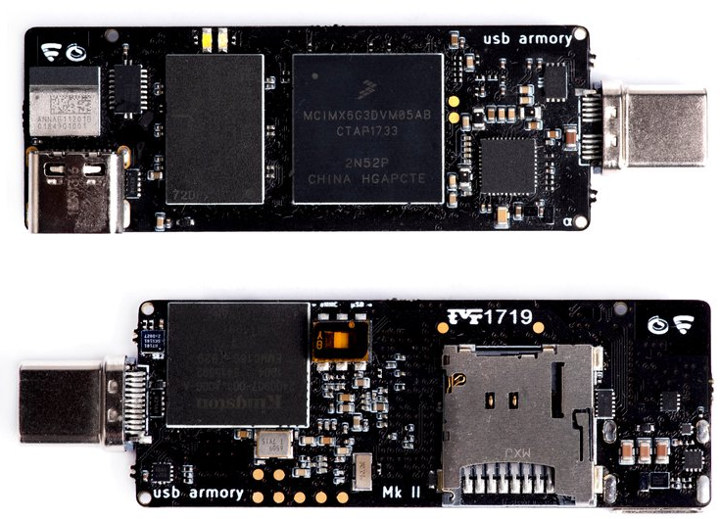
Back in 2014, Inverse Path launched USB Armory computer dongle running headless Linux from a MicroSD card and designed for security applications. The company got bought by F-Secure Foundry in 2017, and the latter has now launched another crowdfunding campaign for an upgraded version
USB Armory Mk II keeps a similar USB dongle form factor but replaces the NXP i.MX53 Cortex-A8 processor with a more efficiency NXP i.MX 6ULZ Arm Cortex-A7 processor, the USB type-A port with a modern USB-C port, adds 16GB eMMC flash, Bluetooth 5 LE connectivity, and new security features.
The USB computer dongle can run various Linux distributions such as Debian and Ubuntu, but also Android and FreeBSD booting from either the eMMC flash or a MicroSD card. USB device emulation enables CDC Ethernet, mass storage, HID, etc…
Some potential security applications made possible by USB Armory Mk II include advanced mass storage device with automatic encryption, virus scanning, host authentication, and data self-destruct…, OpenSSH client and agent for untrusted hosts such as Internet kiosks, VPN router for end-to-end VPN tunnelling, Tor bridge, password manager with integrated web server, portable penetration testing platform, and so on.

»
-

- Login or register to post comments
 Printer-friendly version
- 2251 reads
 PDF version
More in Tux Machines
- Highlights
- Front Page
- Latest Headlines
- Archive
- Recent comments
- All-Time Popular Stories
- Hot Topics
- New Members
digiKam 7.7.0 is released
After three months of active maintenance and another bug triage, the digiKam team is proud to present version 7.7.0 of its open source digital photo manager. See below the list of most important features coming with this release.
|
Dilution and Misuse of the "Linux" Brand
|
Samsung, Red Hat to Work on Linux Drivers for Future Tech
The metaverse is expected to uproot system design as we know it, and Samsung is one of many hardware vendors re-imagining data center infrastructure in preparation for a parallel 3D world.
Samsung is working on new memory technologies that provide faster bandwidth inside hardware for data to travel between CPUs, storage and other computing resources. The company also announced it was partnering with Red Hat to ensure these technologies have Linux compatibility.
|
today's howtos
|


 Content (where original) is available under CC-BY-SA, copyrighted by original author/s.



Recent comments
1 year 11 weeks ago
1 year 11 weeks ago
1 year 11 weeks ago
1 year 11 weeks ago
1 year 11 weeks ago
1 year 11 weeks ago
1 year 11 weeks ago
1 year 11 weeks ago
1 year 11 weeks ago
1 year 11 weeks ago