



Complete PureBoot Demo and More Progress
Submitted by Roy Schestowitz on Monday 29th of April 2019 07:52:54 PM
Filed under 

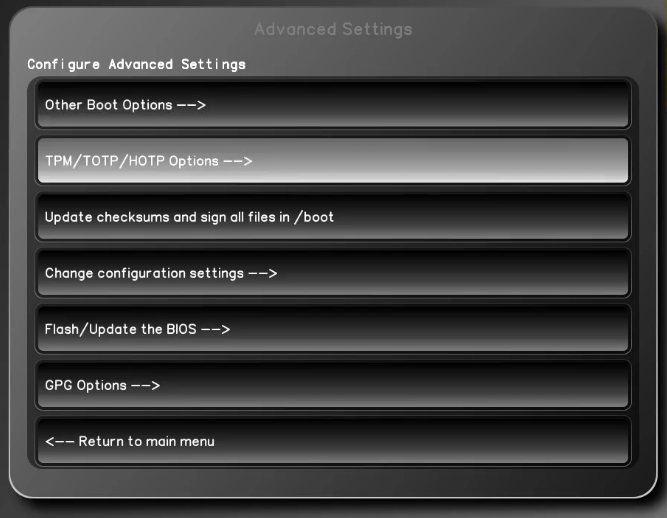
The video, as you can see, starts with powering on the Librem Laptop with a Librem Key inserted. PureBoot then starts by checking the firmware for tampering and authenticating itself to the Librem Key, which blinks green to indicate the system is safe.
Next we select the Default Boot option, and PureBoot scans the /boot directory for any tampering – and if and when it doesn’t find any, it starts booting the OS as normal.
Once the OS boots, you see a prompt show up on the screen requesting the user’s GPG PIN, which demonstrates PureBoot unlocking disk encryption using the Librem Key instead of a passphrase. We find this approach to be more convenient for the user than typing in a long passphrase; and being a 2-factor authentication, it’s more secure too.
Finally we reboot the machine and simulate tampering, by storing a new shared secret in the TPM chip without the Librem Key inserted. Once we do reboot, PureBoot detects and warns us that the Librem Key isn’t inserted. We could skip this warning and boot anyway, but we insert it and then the Librem Key flashes red to warn us that there was tampering.

Also: Purism's PureBoot Advancing, Closer To Shipping With Their New Laptops
»
-

- Login or register to post comments
 Printer-friendly version
- 1872 reads
 PDF version
More in Tux Machines
- Highlights
- Front Page
- Latest Headlines
- Archive
- Recent comments
- All-Time Popular Stories
- Hot Topics
- New Members
digiKam 7.7.0 is released
After three months of active maintenance and another bug triage, the digiKam team is proud to present version 7.7.0 of its open source digital photo manager. See below the list of most important features coming with this release.
|
Dilution and Misuse of the "Linux" Brand
|
Samsung, Red Hat to Work on Linux Drivers for Future Tech
The metaverse is expected to uproot system design as we know it, and Samsung is one of many hardware vendors re-imagining data center infrastructure in preparation for a parallel 3D world.
Samsung is working on new memory technologies that provide faster bandwidth inside hardware for data to travel between CPUs, storage and other computing resources. The company also announced it was partnering with Red Hat to ensure these technologies have Linux compatibility.
|
today's howtos
|


 Content (where original) is available under CC-BY-SA, copyrighted by original author/s.



Recent comments
1 year 11 weeks ago
1 year 11 weeks ago
1 year 11 weeks ago
1 year 11 weeks ago
1 year 11 weeks ago
1 year 11 weeks ago
1 year 11 weeks ago
1 year 11 weeks ago
1 year 11 weeks ago
1 year 11 weeks ago