
news
Original screenshot courtesy of hikari_no_yume
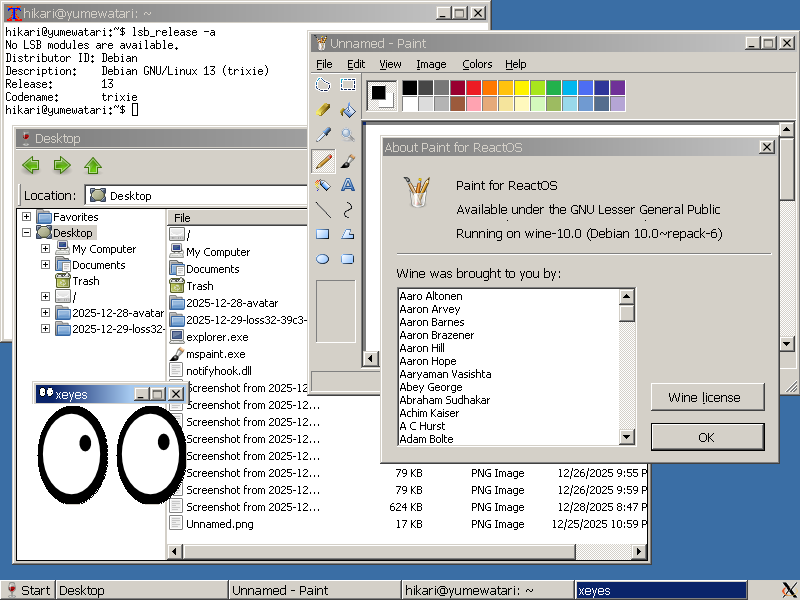
Quoting: loss32 is a Linux Distro Nobody Asked For (But Still Has Its Usage) —
The project makes it a point to differentiate itself from others like ReactOS, which, as the developer notes, tries to reimplement the Windows NT kernel and has struggled with hardware compatibility and stability.
But loss32 does take some components from ReactOS, most notably the user space ones, to achieve a similar desktop experience while making use of a more practical foundation comprised of Linux and Wine to bring it all together.
This is the brainchild of hikari_no_yume, who wants to preserve the late 90s to early 2010s PC desktop experience that was beloved by power users.
She also argues that a desktop environment where everything runs inside Wine would create strong incentives to improve Wine for everyone, addressing the rough edges people currently tolerate only as a last resort.
Original Post:
-
loss32: let's build a Win32/Linux
I'd just like to interject for a moment. What you're referring to as Linux, is in fact, Win32/Linux, or as I've recently taken to calling it, loss32 Win32 plus Linux. Linux is not an operating system unto itself, but rather another free component of a fully functioning system made useful by WINE, the ReactOS userland, and other vital system components comprising a full OS as defined by Microsoft.
A dream of a Linux distribution where the entire desktop environment is Win32 software running under WINE. A completely free and open-source OS where you can just download .exe files and run them, for the power user who isn't necessarily a Unixhead, or just for someone who thinks this sounds fun.
ReactOS tries to reimplement the Windows NT kernel, and that has always been its Achilles heel, holding it back from a hardware compatibility and stability standpoint. The loss32 concept is to achieve a similar-feeling end result to ReactOS, but built on a more usable foundation, using components known to work well (the Linux kernel, WINE, everything that glues those together, and a sprinkling of ReactOS userland niceties). As a bonus, the OS would still technically be a Linux distro, so it would be possible to run Linux software when necessary, something ReactOS can't do.