



The Helios microkernel
Submitted by Roy Schestowitz on Monday 13th of June 2022 02:47:35 PM
Filed under 
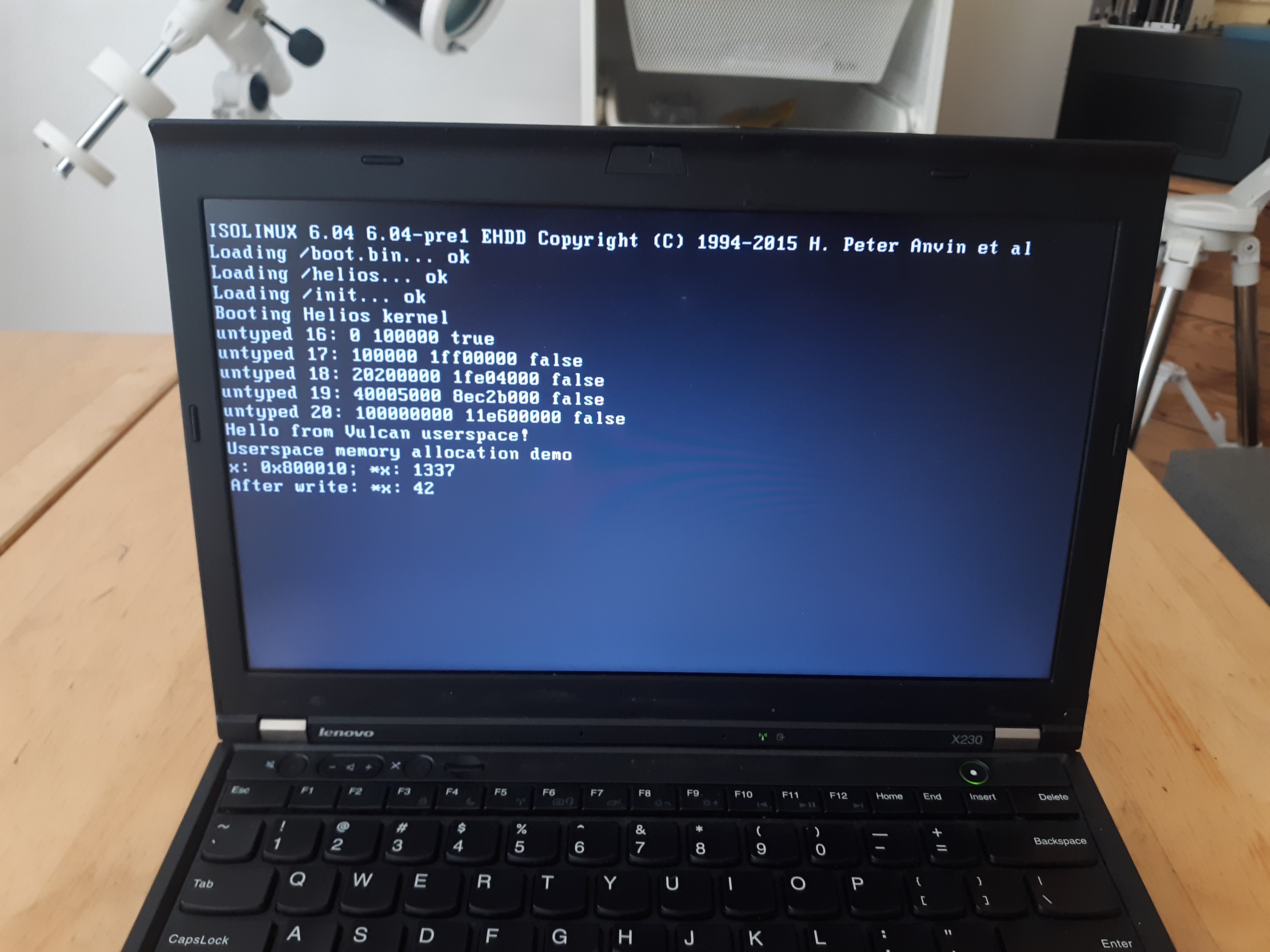
I’ve been working on a cool project lately that I’d like to introduce you to: the Helios microkernel. Helios is written in Hare and currently targets x86_64, and riscv64 and aarch64 are on the way. It’s very much a work-in-progress: don’t expect to pick this up and start building anything with it today.
Drawing some inspiration from seL4, Helios uses a capability-based design for isolation and security. The kernel offers primitives for allocating physical pages, mapping them into address spaces, and managing tasks, plus features like platform-specific I/O (e.g. reading and writing x86 ports). The entire system is written in Hare, plus some necessary assembly for the platform bits (e.g. configuring the GDT or IDT).
Things are still quite early, but I’m pretty excited about this project. I haven’t had this much fun hacking in some time  We have several kernel services working, including memory management and virtual address spaces, and I’ve written a couple of simple drivers in userspace (serial and BIOS VGA consoles). Next up is preemptive multi-tasking — we already have interrupts working reliably, including the PIT, so all that’s left for multi-tasking is to actually implement the context switch. I’d like to aim for an seL4-style single-stack system, though some finageling will be required to make that work.

»
-

- Login or register to post comments
 Printer-friendly version
- 1790 reads
 PDF version
More in Tux Machines
- Highlights
- Front Page
- Latest Headlines
- Archive
- Recent comments
- All-Time Popular Stories
- Hot Topics
- New Members
digiKam 7.7.0 is released
After three months of active maintenance and another bug triage, the digiKam team is proud to present version 7.7.0 of its open source digital photo manager. See below the list of most important features coming with this release.
|
Dilution and Misuse of the "Linux" Brand
|
Samsung, Red Hat to Work on Linux Drivers for Future Tech
The metaverse is expected to uproot system design as we know it, and Samsung is one of many hardware vendors re-imagining data center infrastructure in preparation for a parallel 3D world.
Samsung is working on new memory technologies that provide faster bandwidth inside hardware for data to travel between CPUs, storage and other computing resources. The company also announced it was partnering with Red Hat to ensure these technologies have Linux compatibility.
|
today's howtos
|


.svg_.png)

 Content (where original) is available under CC-BY-SA, copyrighted by original author/s.


Recent comments
43 weeks 21 hours ago
43 weeks 21 hours ago
43 weeks 23 hours ago
43 weeks 1 day ago
43 weeks 1 day ago
43 weeks 1 day ago
43 weeks 1 day ago
43 weeks 2 days ago
43 weeks 2 days ago
43 weeks 2 days ago