
news
Best Free and Open Source Software, howtos and Installations
-
9 Best Free and Open Source Recursive DNS Resolvers
A recursive DNS resolver handles this lookup on behalf of a client. If the answer is not already in its cache, the resolver follows the DNS hierarchy, querying root servers, top-level domain servers and ultimately the authoritative server responsible for the requested domain. It then returns the answer to the client and usually caches the result so future requests can be answered more quickly.
This differs from an authoritative DNS server. An authoritative server stores and serves DNS records for domains under its control. It does not normally search elsewhere for an answer. A recursive resolver, by contrast, is concerned with finding answers, validating them where appropriate, and returning them to users or applications.
The terminology can be slightly confusing because a recursive resolver is itself a type of DNS server. The important distinction is the role it performs. Recursive resolvers may also provide caching, DNSSEC validation, access controls, filtering, encrypted DNS support and policy features. Running your own resolver can provide greater control over DNS behaviour, privacy, security and performance.
Here’s our verdict on the finest recursive DNS resolvers captured in a legendary LinuxLinks-style ratings chart. Only free and open source software is eligible for inclusion.
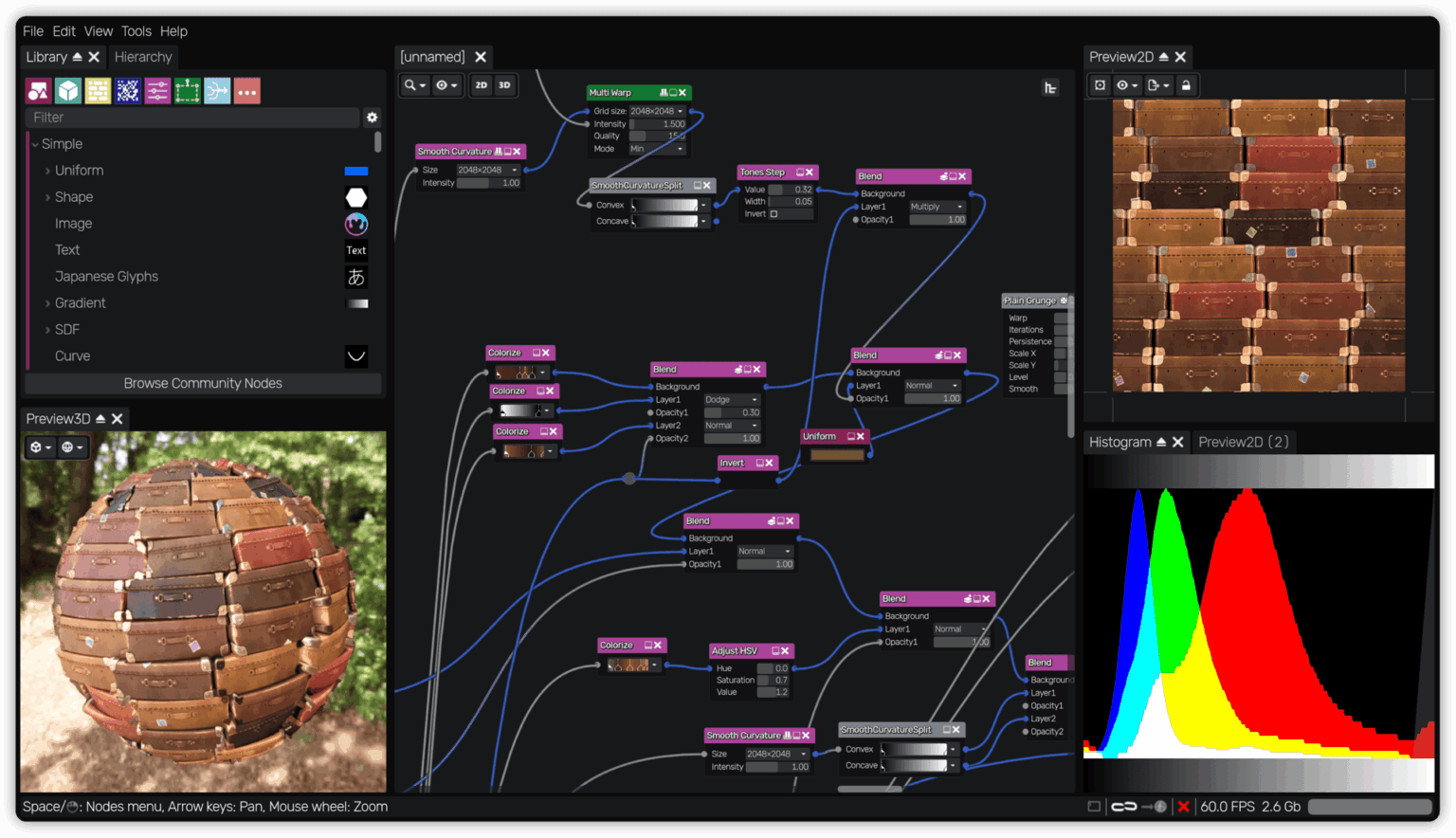
Best Free and Open Source Alternatives to Adobe Substance 3D Designer
Substance 3D Designer is Adobe’s material authoring application. It uses a node-based workflow to create procedural textures, seamless materials, patterns, image filters and environment lighting. Graphs are non-destructive and parametric, allowing individual stages to be changed without rebuilding the material from scratch.
The software can generate multiple texture outputs from the same graph and provides a large collection of noises, generators, filters and other building blocks. This makes it particularly useful for creating reusable PBR materials rather than painting a single texture directly onto a model.
Unlike many Adobe applications, Substance 3D Designer does have Linux support. Adobe currently supports RHEL for enterprise users and Ubuntu through the Steam edition. However, it remains proprietary software.
We recommend the best free and open source alternatives.
LocalGo - LocalSend-compatible command-line file sharing
LocalGo is a command-line implementation of the LocalSend v2.1 protocol.
It provides secure cross-platform file sharing between LocalGo and compatible LocalSend devices, with support for device discovery, direct transfers, clipboard sharing and browser-based downloads. It is particularly suitable for terminal users, servers and headless systems where a graphical LocalSend client is unnecessary.
This is free and open source software.
Dionaea - honeypot for capturing exploit and malware activity
Dionaea is a network honeypot built to attract hostile traffic and record what attackers do when they encounter apparently vulnerable services. It was conceived as a successor to Nepenthes and is particularly suited to collecting information about automated attacks, exploitation attempts and malicious network activity.
Rather than concentrating solely on usernames and passwords, Dionaea exposes a broad collection of network services that attackers and automated scanners can interact with. This makes it useful for observing exploitation behaviour across several classes of service from a single deployment. Its architecture also embeds Python as a scripting language, allowing functionality to be extended without implementing everything in the core.
This is free and open source software.
worldclock-tty - real-time terminal-based world clock
worldclock-tty is a terminal-based world clock that displays local time alongside multiple time zones in real time.
It is particularly useful for users working with people or systems spread across different regions, providing a compact view without requiring a graphical application. Time zones are configurable using standard IANA names, while display options cover sorting, time formats, UTC offsets, colours, themes, military time, and refresh intervals.
This is free and open source software.
OpenCanary - modular multi-protocol network honeypot
OpenCanary is a lightweight network honeypot designed to reveal intruders who are exploring systems they should not be accessing. It runs as a daemon and presents decoy network services that look potentially useful to an attacker. Interactions with these services are recorded and can generate alerts, providing an early indication of reconnaissance or lateral movement inside a network.
The software is deliberately economical with resources, making it practical to distribute multiple sensors around an environment rather than relying on a single large honeypot. It can run on modest virtual machines and low-power hardware. Operators select the services they want to expose and customise their behaviour through configuration rather than maintaining deliberately vulnerable applications.
This is free and open source software.
Tasks – simple task manager for the COSMIC desktop
Tasks is a graphical task management application designed for the COSMIC desktop.
It provides a straightforward way to create, arrange and find to-do items while following COSMIC interface conventions. The program supports reminders, search, manual ordering and list organisation, with recovery options for deleted material. It is available through Flathub and can also be built from source using Rust and libcosmic.
This is free and open source software.
NPBackup - secure and efficient file backup solution
Probably one of the most important software applications, but often neglected, is the backup program. The best Linux backup software will keep you covered when you accidentally delete files, or when a disk bites the dust. Backup software protects a variety of file types, including documents, databases, photos, music, and videos. Backup software provides an automated solution for creating, managing, and restoring data from backups.
There are different types of backup software including full backup software, incremental backup software, and image backup software.
NPBackup is a backup application aimed at both system administrators and desktop users. It builds on the established restic backup engine, adding graphical and command-line interfaces, configuration management, scheduling, monitoring and support for multiple repositories. Backup repositories remain fully compatible with restic.
Lumalarm - smart alarm clock that wakes your computer from sleep
Lumalarm is a smart alarm clock designed specifically for Linux.
Unlike conventional alarm applications that require the computer to remain running, Lumalarm can suspend the machine using rtcwake and schedule it to wake shortly before an alarm sounds. It also offers mechanisms intended to make dismissing an alarm more deliberate, including typing and mathematical challenges and follow-up checks to confirm that you’re still awake. The interface is built with Qt Quick and is highly customisable, with particular attention paid to compositors and tiling window managers.
This is free and open source software.
Talisman - detect sensitive data before Git commits
Talisman is a command-line security tool designed to stop sensitive information leaving a developer’s workstation through Git.
It examines outgoing changesets for material that looks suspicious, such as passwords, tokens and private keys, and is commonly used as a pre-commit or pre-push hook. It can also run as a standalone executable, making the same checks available outside the normal Git hook path. The emphasis is on catching mistakes early, before credentials reach a shared repository where remediation becomes more difficult.
This is free and open source software.
Kactus2 - graphical EDA tool based on the IP-XACT standard
Kactus2 is a graphical Electronic Design Automation toolset for designing systems-on-chip. Its focus is on improving IP reuse and integration across hardware and software development. It works with IP-XACT descriptions and supports both the IEEE 1685-2014 and IEEE 1685-2022 standards.
Kactus2 can package existing intellectual property as reusable IP-XACT components, build hierarchical hardware designs, describe connections between components, manage memory maps, and integrate software with the underlying hardware. It is not intended for behavioural logic, synthesis, or simulation; these stages are left to specialised tools.
This is free and open source software.
clock-rs - modern digital clock for your terminal
clock-rs is a modern digital clock for the terminal. It is designed as an alternative to tty-clock, adding extensive configuration together with timer and stopwatch functionality. Settings can be stored in a TOML configuration file while individual values can be overridden from the command line. The clock supports major desktop operating systems and adapts well to both permanent terminal displays and occasional use.
This is free and open source software.
typa - minimal terminal typing speed test
typa is a lightweight terminal user interface (TUI) application for testing and improving typing speed. It offers a keyboard-centric alternative to browser-based typing tests and supports several testing modes covering ordinary words, quotations, and source code.
The program reports typing speed and accuracy in detail after each run. It also maintains typing history and supports multiple languages, configurable themes, and command-line options for quickly constructing a test without navigating menus.
This is free and open source software.