
news
LWN's Latest: Linux 7.3, Remind, Licensing, and Hype
-
Linux
-
Kernel Space / File Systems / Virtualization
-
LWN ☛ The beginning of the 7.3 merge window
As of this writing, 2,346 non-merge changesets have been pulled into the mainline repository for the 7.3 kernel release. That, clearly, is a mere down payment on the flood that is to come. Even so, those early pulls brought in some noteworthy changes, including (but not limited to) a significant reworking of how group scheduling works on multiprocessor systems.
-
-
Applications
-
LWN ☛ Old-school calendaring at the command line with Remind
Remind is a command-line calendar and alarm program, with an optional Tk-based graphical interface, for Linux and Unix-like operating systems. It has its own scripting language that allows users to create reminders that are difficult (if not impossible) to specify in other calendaring programs. It is wholly unsuitable for use in corporate environments that require calendar sharing and exchanging meeting invitations; however, it may be precisely the calendaring tool for users who prefer the command line and fast, flexible tools that can help keep track of messy schedules.
-
-
-
Free, Libre, and Open Source Software
-
Licensing / Legal
-
LWN ☛ An ongoing 3D-printer AGPL violation
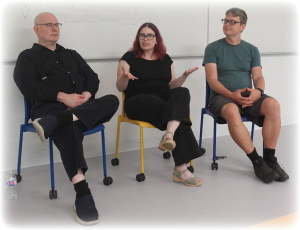
At FOSSY 2026, several people from the Software Freedom Conservancy (SFC), which organizes the conference, gave a presentation about an ongoing violation of the Affero General Public License version 3 (AGPLv3). Bradley Kühn, Karen Sandler, and Denver Gingerich spoke about different aspects of the violation, which is in regard to 3D-printer software from Bambu Lab, and what is being done to try to provide users with alternatives. One aspect that is particularly interesting is that the circumvention that the company is employing is precisely what the AGPL was written to prevent.
[...]
Some time ago, 3D printing was invented, which is something that he watched from afar; a breadboard fire when he was an undergraduate convinced him that he should be a software-only person. He is a fan of the 3D-printing culture, and enjoys the talks that come from it, but he does not participate. As part of the license-violation investigation, he and Gingerich did a crash course in the history of 3D-printing, though Gingerich already had much of the background.
-
LWN ☛ Considering the OpenMDW license [Ed: So-called 'Linux' Foundation and IBM (Dolan) using OSI like a private toilet for openwashing purposes and slop]
The open-source world has been struggling for a few years now to understand how to approach large language models (LLMs) and the licensing applied to them. What constitutes "freedom" with respect to a black box filled with numerical weights? The process taken by the Open Source Initiative (OSI) in the development of its Open Source AI Definition was controversial at best, as was its output. Now, the Linux Foundation's Mike Dolan has brought a new license to the OSI for approval. It is called the OpenMDW ("Open Model, Data, and Weights"), and it aims to clarify licensing for the distribution of LLMs and related materials, but consensus is proving hard to find for this license as well.
-
-
Programming/Development
-
LWN ☛ A look at the Quickshell desktop-component toolkit
Quickshell is a toolkit for building desktop components, such as toolbars or menus. It uses QML, which is a declarative language for designing GUI applications. Quickshell helps developers create graphical tools for common desktop use cases with a focus on ease of development. It offers a convenient method for writing user interfaces and has been adopted by a number of projects, such as caelestia-shell and DankMaterialShell, that provide desktop environments for minimal window managers like Sway and niri.
-
-
-
Leftovers
-
Security
-
LWN ☛ How to be safe from quantum computing [Ed: More quantum hype, scaring people using something that does not exist or barely exists]
Practical quantum computers have been ten years away for the last several decades. Now, however, it's beginning to look as though they will be possible in just a few years. Recent research with obfuscated results demonstrated much lower memory requirements to factor ECDSA keys on a quantum computer, with work by other researchers in the open more than halving memory use compared to the state of the art in 2023. At the same time, computer manufacturers are boasting quantum processors that retain viable superpositions over longer periods. Given how slowly software updates filter out to stable systems, it's worth looking at what configuration changes and protocol updates are needed to be safe from quantum computers now.
-
-