
news
Good News! CERN is Migrating Over 2,200 Control Systems to Debian 13
Quoting: Good News! CERN is Migrating Over 2,200 Control Systems to Debian 13 —
Debian has gotten some good press thanks to Federico Vaga and Nikos Tsipinakis, who presented a talk at MiniDebConf Winterthur this past weekend.
The two CERN engineers laid out why the organization is moving its particle accelerator control computers onto Debian 13, with more than 2,200 industrial computers and embedded systems set to run it by the end of 2026.
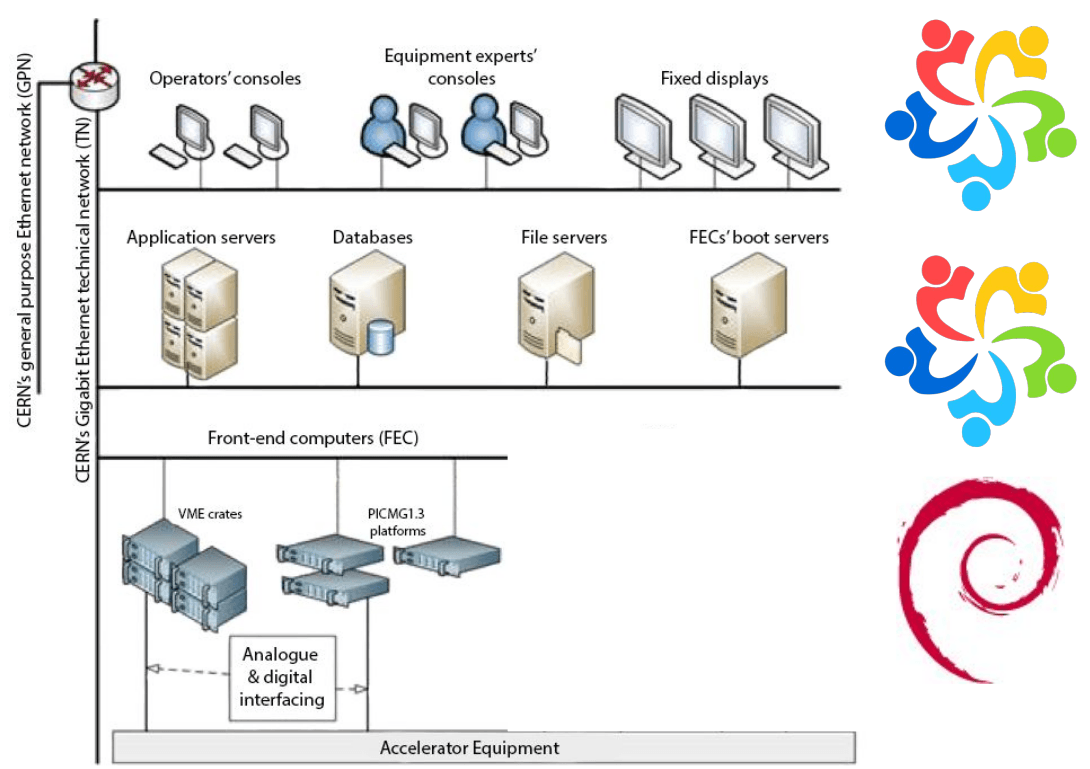
Though this doesn't mean that the whole CERN IT infrastructure is being moved. The migration is specific to the accelerator control layer—the front-end computers that talk directly to the equipment running the beam.
Update
More in Neowin:
-
CERN set to switch over 2,200+ machines to Debian 13
CERN was keen to point out that not all of its machines will be running Debian, some, like their servers, will stick with RHEL and AlmaLinux.
Phoronix:
-
CERN Transitioning Industrial Computers To Debian After Being A Longtime RHEL Institution
CERN talked about this exciting news at the MiniDebConf that took place in Winterthur, Switzerland this past weekend. CERN had used their RHEL-derived Scientific Linux for about a decade prior to moving to CentOS in 2015. Now after a decade with CentOS, they are moving on and embracing Debian for a portion of their systems.
Late coverage:
-
CERN is moving more than 2,200 specialized computers from RHEL to Debian
CERN engineers have unveiled a complex plan to move a number of computers to a new Linux distribution. The upgrade is required to prevent older, specialized hardware from becoming obsolete, though it's turning out to be a challenging endeavor.
During a recent conference held in Winterthur, Switzerland, engineers working at the European Organization for Nuclear Research (CERN) confirmed that the laboratory is going to move from Red Hat Enterprise Linux to Debian. The switch will affect more than 2,200 computers, many of which cannot be upgraded to newer RHEL releases because newer Red Hat releases will leave much older hardware behind.
More here:
-
CERN Renounces RHEL in Favor of Debian for Its Accelerator Controls Infrastructure
CERN engineers announced a shift from Red Hat-based distributions to Debian for its accelerator control systems. This decision stems from Red Hat's tightening compiler mandates, which threatened legacy hardware. The transition, focused on 2,200 specialized control machines, is set for completion in late 2026, while CERN's other systems will remain with Red Bait and AlmaLinux.
By Olimpiu Pop
LWN:
-
CERN's migration path from CentOS Linux to Debian
The European Laboratory for Particle Physics, usually just called CERN, is not only the birthplace of the World Wide Web, it is home to the Large Hadron Collider (LHC), the world's largest and highest-energy particle accelerator. As such, its computing environment is both truly unique and of great interest to people outside of CERN who hope to find lessons applicable to their own computing needs. The upcoming migration of some of CERN's systems from CentOS Linux to Debian, which was the topic of a talk at the recent MiniDebConf Winterthur 2026, is of particular interest.
Late coverage:
-
CERN Moves To Debian
CERN, the European Organization for Nuclear Research, is moving away from using versions of Linux based on Red Hat distributions to use Debian instead - for at least part of its infrastructure.
CERN is famous as the home of the Large Hadron Collider, and as being the place the World Wide Web was invented. The news of the change in operating system choice emerged in a session given by CERN engineers Federico Vaga and Nikos Tsipinakis at MiniDebConf Winterthur, held in Winterthur, Switzerland at the end of August.
LWN (not otuside paywall):
-
CERN's migration path from CentOS Linux to Debian
Federico Vaga and Nikos Tsipinakis, both CERN employees, delivered the talk "Controlling CERN's Accelerators with Debian" (video and slides) on August 30. I was not fortunate enough to attend in person, but watched the video of the talk shortly after.